Advertisements
Advertisements
प्रश्न
The following line is given to you. Find its appropriate meaning after discussing it with your partner.
If you gladly sweat for, fret for and plan for it.
Advertisements
उत्तर
Engaging in work with a positive and joyful mindset, coupled with thorough planning, ensures a higher probability of achieving success.
APPEARS IN
संबंधित प्रश्न
Get into pairs, discuss and tick the most appropriate answer :
Success is always measured by :
Complete the following table.
Make a list of great personalities of present and past who have achieved success in different walks of life. You can take help from your school library or search on the internet.
| Politics | Social work | Sports | Music |
Do you think the line ‘Give up your time and your peace and your sleep for it’ means that one should be ‘desperate’ or restless’ to achieve one’s goal? Explain your opinion, in your notebook.
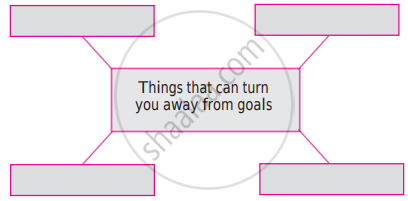
Read the poem again and complete the web showing all those things that can turn one away from one's efforts towards a goal.
Find the line from the poem which mean-
become crazy for the goal
Find the line from the poem which mean-
make efforts continuously
The poet has mentioned some hurdles in the poem that keep us away from achieving our goal in our life. Discuss with your partner and make a list of all the hurdles mentioned in the poem.
- sickness
Every stanza begins with the word ‘if’. How does it add to the effectiveness of the poem?
Make a list of Berton Braley’s collection of selected poems. You can take the help of your teacher, library, or search on the internet. Recite Braley’s one poem in front of the class.
Read the following poem and write an appreciation of the poem ‘The Will to Win’ in a paragraph format.
|
The Will to Win If you want a thing bad enough If all that you dream If you gladly sweat for, fret for and plan for it and lose If you simply go after that thing that you want with all If neither cold poverty, famished or gaunt If dogged and grim you besiege and beset it, - Berton Braley |
Points-
- Title and Poet
- Rhyme scheme
- Figures of speech
- Theme/Central idea
- Favourite line
- Special features - Type of the poem, language, tone, implied meaning, etc.
- Why I like/dislike the poem.
