The Figures Given Below Are Cross-sections of Blood Vessels. (I) Identify the Blood Vessels A, B, and C. (Ii) Name the Parts Labeled 1-4. (Iii) Mention Two Structural Differences Between a and B.
Advertisements
प्रश्न
The figures given below are cross-sections of blood vessels.
(i) Identify the blood vessels A, B, and C.
(ii) Name the parts labeled 1-4.
(iii) Mention two structural differences between A and B.
(iv) Name the type of blood A that flows (a) through A, (b) through B.
(v) In which of the above vessels referred to in (iv) above does exchange of gases actually take place?
Advertisements
उत्तर
(i)
(A) Artery
(B) Vein
(C) Capillary.
(ii)
1. Connective tissue
2. Lumen.
3. Tunica media.
4. Tunica intima/Endothelium.
(iii) Two structural differences between arteries and veins are :
(a) Arteries are thick-walled and veins are thin walled.
(b) There are no valves in arteries while valves are present in veins.
(iv) (a) Oxygenated blood flows through A.
(b) Deoxygenated blood flows through B.
(v) The exchange of gases takes place in C capillaries.
संबंधित प्रश्न
A blood vessel which carries blood back to the heart is ______.
The blood vessel which carries oxygenated blood from the lungs to the heart is ______.
Define the term Arteries.
Write in brief about the following:
Blood transfusion.
How many litres of blood does an adult human body have?
What is blood pressure? When does it rise?
The following simplified diagram refers to the outline plan of the circulation of blood in a mammal. Study the diagram and write the number and name of the blood vessel in each case as mentioned ahead.
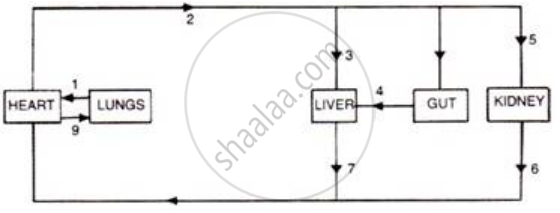
Which vessel would contain the highest concentration of amino acids and glucose soon after a meal?
Can the blood dot inside the blood vessels. Give reason in support of your answer.
Complete the following sentence with appropriate word:
The blood vessel which transports blood from heart to an organ is called _________.
Why is the velocity of blood flow the lowest in the capillaries?
