Advertisements
Advertisements
प्रश्न
The body of sponges does not possess tissue level of organisation though it is made of thousands of cells. Comment.
Advertisements
उत्तर
Though all members of Animalia are multicellular, all of them do not exhibit the same pattern of organisation of cells. For example, in sponges, the cells are arranged as loose cell aggregates, i.e. they exhibit the cellular level of organisation. Some division of labour (activities) occurs among the cells. Hence, the body of sponges does not possess a tissue level of organisation.
APPEARS IN
संबंधित प्रश्न
Describe various types of epithelial tissues with the help of labelled diagrams
Based on the following information, identify the three types of epithelial tissue in the figures given below :
| a | 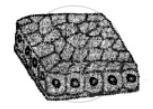 |
b | 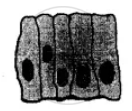 |
c | 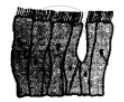 |
(1) Cuboidal epithelium: It consists of a single layer of cuboidal cells.
(2) Columnar epithelium: It is composed of tall, cylindrical cells with oval nuclei usually placed at the base of the cells.
(3) Ciliated epithelium: It consists of cells being hair-like cilia on their free surface.
Name the kind of cells found in the following place:
Inner lining of the wind pipe
Name any one body part where ciliated epithelium is found in humans. What is its function?
How many types of epithelial tissues have you studied? Write their functions.
Give structure, types and functions in brief of the following:
Epithelial tissue
Name the tissues found
at the outer layer of skin.
Answer the following question.
What is cell junction?
Epithelial cells with cilia are found in ______ of our body.
Lining of small intestine is made up of ______.
State whether true or false. If false, correct the statement.
Epithelial tissue is protective tissue in animal body.
Prevention of substances from leaking across the tissue is provided by ______.
What is an epithelium? Enumerate the characteristic features of different epithelia.
The dead element present in the phloem is
A long tree has several branches. The tissue that helps in the side ways conduction of water in the branches is
Differentiate between sclerenchyma and parenchyma tissues. Draw well labelled diagram.
An epithelial layer does not allow the regulation of materials between the body and the external environment.
Sieve cells have no companion cells.
Which one of the following types of cell is involved in making of the inner walls of blood vessels?
Match List I with List II.
| List I | List II |
| A. Mast cells | I. Ciliated epithelium |
| B. Inner surface of bronchiole | II. Areolar connective tissue |
| C. Blood | III. Cuboidal epithelium |
| D. Tubular parts of nephron | IV. specialised connective tissue |
Choose the correct answer from the options give below:
