Advertisements
Advertisements
प्रश्न
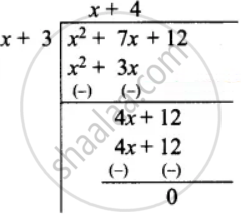
The area of a rectangle is x2 + 7x + 12. If its breadth is (x + 3), then find its length
Advertisements
उत्तर
Let the length of the rectangle be “l”
The breadth of the rectangle = x + 3
Area of the rectangle = length × breadth
x2 + 7x + 12 = l(x + 3)
l = `(x^2 + 7x + 12)/(x + 3)`
= `((x + 4)(x + 3))/(x + 3)`
= x + 4
Length of the rectangle = x + 4
APPEARS IN
संबंधित प्रश्न
On dividing x3 – 3x2 + x + 2 by a polynomial g(x), the quotient and remainder were x – 2 and –2x + 4, respectively. Find g(x)
Give examples of polynomials p(x), g(x), q(x) and r(x), which satisfy the division algorithm
deg r(x) = 0
Apply division algorithm to find the quotient q(x) and remainder r(x) on dividing f(x) by g(x) in the following:
f(x) = x3 – 6x2 + 11x – 6, g(x) = x2 + x + 1
Apply division algorithm to find the quotient q(x) and remainder r(x) on dividing f(x) by g(x) in the following:
f(x) = 15x3 – 20x2 + 13x – 12, g(x) = 2 – 2x + x2
Find all the zeros of the polynomial 2x3 + x2 – 6x – 3, if two of its zeros are `-sqrt(3)` and `sqrt(3)`.
Find all the zeros of the polynomial x3 + 3x2 – 2x – 6, if two of its zeros are `-sqrt(2)` and `sqrt(2)`.
Verify division algorithm for the polynomial f(x)= (8 + 20x + x2 – 6x3) by g(x) = (2 + 5x – 3x2).
The sum of (x + 5) observations is (x3 + 125). Find the mean of the observations
Which one of the following statements is correct?
Can x2 – 1 be the quotient on division of x6 + 2x3 + x – 1 by a polynomial in x of degree 5?
