Advertisements
Advertisements
प्रश्न
The angles of elevation of the top of a tower from two points at a distance of 4 m and 9 m from the base of the tower and in the same straight line with it are complementary. Prove that the height of the tower is 6 m.
The angles of elevation of the top of a tower from two points at distances of 4 m and 9 m from the base of the tower and in the same straight line with it are complementary. Show that the height of the tower is 6 metres.
Advertisements
उत्तर १
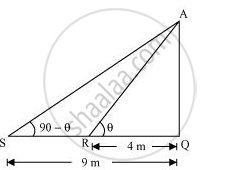
Let AQ be the tower and R, S are the points 4 m, 9 m away from the base of the tower respectively.
The angles are complementary. Therefore, if one angle is θ, the other will be 90 − θ.
In ΔAQR,
`(AQ)/(QR) = tan θ`
`(AQ)/4 = tan θ` ...1
In ΔAQS,
`(AQ)/(SQ) = tan(90 - θ)`
`(AQ)/9 = cot θ` ...2
On multiplying equations (i) and (ii), we obtain
`((AQ)/4)((AQ)/9) = (tan θ).(cot θ)`
`(AQ^2)/36 = 1`
`AQ^2 = 36`
`AQ = sqrt36 = +-6`
However, height cannot be negative.
Therefore, the height of the tower is 6 m.
उत्तर २
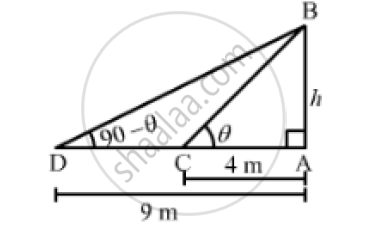
Let AB be the tower and C and D be two points such that AC = 4m and AD 9m.
Let:
`AB = hm, ∠BCA=theta and ∠BDA= 90° - theta`
In the right ΔBCA,we have:
`tan theta = (AB)/(AC)`
`⇒ tan theta = h/4 ` ...............(1)
In the right ΔBDA,we have:
` tan (90° - theta ) = (AB) /(AD)`
`⇒ cot theta = h/9 [ tan (90° - theta ) = cot theta]`
`⇒1/ tan theta = h/9 ................(2) [ cot theta = 1/ tan theta]`
Multiplying equations (1) and (2), we get
`tan theta xx 1/ tan theta = h/4xxh/9`
`⇒ 1=( h^2)/36`
`⇒ 36=h^2`
`⇒h = +-6`
Height of a tower cannot be negative
∴ Height of the tower = 6 m
