Advertisements
Advertisements
प्रश्न
The angles of a cyclic quadrilateral ABCD are ∠A = (6x + 10)°, ∠B = (5x)°, ∠C = (x + y)°, ∠D = (3y – 10)°. Find x and y, and hence the values of the four angles.
Advertisements
उत्तर
We know that, by property of cyclic quadrilateral,
Sum of opposite angles = 180°
∠A + ∠C = (6x + 10)° + (x + y)° = 180° ......[ ∵ ∠A = (6x + 10)°, ∠C = (x + y)°, given]
⇒ 7x + y = 170° ......(i)
And ∠B + ∠D = (5x)° + (3y – 10)° = 180° .....[∵ ∠B = (5x)°, ∠D = (3y – 10)°, given]
⇒ 5x + 3y = 190°
On multiplying equation (i) by 3 and then subtracting equation (ii) from them, we get
3 × (7x + y) – (5x + 3y) = 510° – 190°
⇒ 21x + 3y – 5x – 3y = 320°
⇒ 16x = 320°
⇒ x = 20°
On putting x = 20° in equation (i), we get
7 × 20 + y = 170°
⇒ y = 170° – 140°
⇒ y = 30°
∴ ∠A = (6x + 10)°
= 6 × 20° + 10°
= 120° + 10°
= 130°
∠B = (5x)°
= 5 × 20°
= 100°
∠C = (x + y)°
= 20° + 30°
= 50°
∠D = (3y – 10)°
= 3 × 30° – 10°
= 90° – 10°
= 80°
Hence, the required values of x and y are 20° and 30°, respectively and the values of the four angles i.e., ∠A, ∠B, ∠C and ∠D are 130°, 100°, 50° and 80°, respectively.
APPEARS IN
संबंधित प्रश्न
Solve the following system of linear equations by using the method of elimination by equating the coefficients √3x – √2y = √3 = ; √5x – √3y = √2
Solve the following pair of linear equation by the elimination method and the substitution method:
3x + 4y = 10 and 2x – 2y = 2
Solve the following pair of linear equation by the elimination method and the substitution method.
`x/2 + (2y)/3 = -1 and x - y /3 = 3`
Form the pair of linear equation in the following problem, and find its solution (if they exist) by the elimination method:
If we add 1 to the numerator and subtract 1 from the denominator, a fraction reduces to 1. It becomes `1/2` if we only add 1 to the denominator. What is the fraction?
Form the pair of linear equation in the following problem, and find its solution (if they exist) by the elimination method:
The sum of the digits of a two-digit number is 9. Also, nine times this number is twice the number obtained by reversing the order of the digits. Find the number.
Form the pair of linear equation in the following problem, and find its solution (if they exist) by the elimination method:
A lending library has a fixed charge for the first three days and an additional charge for each day thereafter. Saritha paid Rs 27 for a book kept for seven days, while Susy paid Rs 21 for the book she kept for five days. Find the fixed charge and the charge for each extra day.
The sum of a two-digit number and the number formed by reversing the order of digit is 66. If the two digits differ by 2, find the number. How many such numbers are there?
The sum of the digits in a two-digits number is 9. The number obtained by interchanging the digits exceeds the original number by 27. Find the two-digit number.
If the length of a rectangle is reduced by 5 units and its breadth is increased by 3 units, then the area of the rectangle is reduced by 9 square units. If length is reduced by 3 units and breadth is increased by 2 units, then the area of rectangle will increase by 67 square units. Then find the length and breadth of the rectangle.
Solve the following simultaneous equation.
x − 2y = −2 ; x + 2y = 10
Solve the following simultaneous equation.
`2/x + 3/y = 13` ; `5/x - 4/y = -2`
By equating coefficients of variables, solve the following equations.
3x - 4y = 7; 5x + 2y = 3
The difference between an angle and its complement is 10° find measure of the larger angle.
Complete the activity.
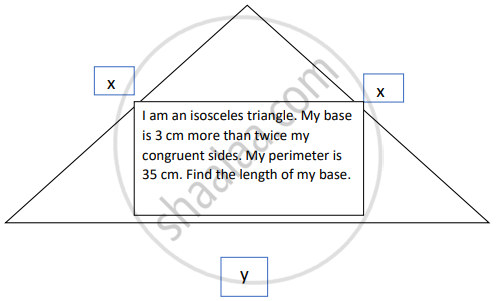
Complete the following table to draw the graph of 3x – 2y = 18.
| x | 0 | 4 | 2 | –1 |
| y | –9 | ______ | ______ | ______ |
| (x, y) | (0, −9) | (______, _______) | (______, _______) | ______ |
Solve: 99x + 101y = 499; 101x + 99y = 501
The angles of a triangle are x, y and 40°. The difference between the two angles x and y is 30°. Find x and y.
Evaluate: (1004)3
A 2-digit number is such that the product of its digits is 24. If 18 is subtracted from the number, the digits interchange their places. Find the number.
Rehana went to a bank to withdraw ₹ 2000. She asked the cashier to give her ₹ 50 and ₹ 100 notes only. Rehana got 25 notes in all. Find how many notes of ₹ 50 and ₹ 100 did she received.
