Advertisements
Advertisements
प्रश्न
“Taxation without Representation” led to the outbreak of American War of Independence – Explain
Advertisements
उत्तर
- A Series of taxes were imposed on the colonists, when the Americans did not have representation in the British Parliament.
- The Sugar Act of 1764, the Currency Act, the Quartering Act of 1765 and the Stamp Act of 1765 – all their Act were protested by the American Colonists.
- They called for a boycott of trade with Britain until the taxes were withdrawn.
- The Townshend Acts of 1767 added fuel to the fire. Merchants of Boston organised boycott of British Goods.
- When Townshend Acts were repealed retaining tax, on tea, it led to the incident of Boston tea party.
- In December 1773, a group of men disguised themselves as Native Americans boarded the cargo vessels and threw the tea overboard.
- This incident, known as Boston Tea Party, was done publicly before a large sympathetic crowd. It was a challenge which led to war between the rebellious colonies and England.
- George Washington became the colonist’s Commander-in-chief and the colonists challenged the right of the British Parliament to tax them against their will.
- “No taxation without representation” was their famous battle cry.
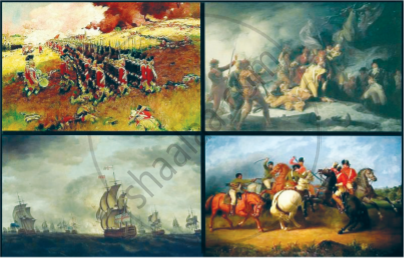
American War of Independence
APPEARS IN
संबंधित प्रश्न
Fill in the blank:
The American War of Independence was the first ______ political revolution in the history of the world.
Fill in the blanks:
French society was divided into three main classes, namely ____________, ___________ and ________.
The French administration was ______ and ______.
Match the following:
| A | B |
| 1. Boston Tea Party | (a) 1789 |
| 2. Declaration of Independence | (b) protest against new taxes |
| 3. Treaty of Paris | (c) middle class |
| 4. French Revolution | (d) 1776 |
| 5. Third Estate | (e) British government and the colonists |
Match the contents of Column A and Column B
| Column A | Column B |
| 1. Boston Tea Party | (a) French thinkers and philosophers |
| 2. Battle of Waterloo | (b) First President of the United States of America |
| 3. Death of Napoleon | (c) England recognised of 13 colonies |
| 4. Louis XVI | (d) King of France |
| 5. 4th July 1776 | (e) Storming of Bastille |
| 6. 1783 | (f) Declaration of Independence at Philadelphia |
| 7. George Washington | (g) 1773 |
| 8. Rousseau, Voltaire, Montesquieu | (h) 1815 |
| 9. 14th July 1789 | (i) 1821 |
Answer the following question
Explain the significance of the American Revolution.
____________was guillotined for organizing a Festival of Liberty and Reason.
Why didn’t the colonies begin fighting for the sake of independence?
State the importance of the battle of Saratoga.
Mention the importance of the victory of the Americans at Yorktown.
