Advertisements
Advertisements
प्रश्न
Take a glass tube open at both ends and clamp it so that its one end dips into a glass cylinder containing water as shown in the accompanying figure. By changing the position of the tube at the clamp, you can adjust the length of the air column in the tube. Hold a vibrating tuning fork of frequency 488 Hz or 512 Hz just above the open end of the tube and make the air column vibrate. What is the difference between the sounds that you hear? The sound will be louder. This is an example of resonance. This set-up is a resonance tube. Note the heights of the air column when you hear louder sound. Interpret your observations.
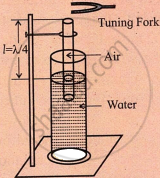
Take another tuning fork of the same frequency as the first one. Vibrate them together above the open end of the tube. Do you hear beats? If the two tuning forks are of same frequency, you should not hear beats. In practice, due to usage, frequencies change and in most of the cases, you will hear beats. If you do not hear beats, there can be two reasons: (i) frequencies of the two forks are exactly same or (ii) the frequencies are very much different (difference greater than 6-7 Hz) and we cannot recognize the beats. Then wind a piece of thread around the tong of one of the tuning fork so that its frequency changes slightly. Try to hear the beats. By changing the position of the thread, vary the frequency and note down your observations systematically. What information you get from this activity?
Advertisements
उत्तर
- When the frequency of the tuning fork matches the natural frequency of the air column, resonance occurs and a louder sound is heard.
- Two tuning forks of nearly equal frequencies produce beats.
- The number of beats heard per second is equal to the difference between their frequencies.
- If the frequencies are exactly equal, no beats are heard.
- If the frequency difference is too large, the beats cannot be clearly recognized.
Thus, the activity demonstrates resonance and the formation of beats.
