Advertisements
Advertisements
प्रश्न
Sumit has bought a closed cylindrical dustbin. The radius of the dustbin is ‘r' cm and height is 'h’ cm. It has a volume of 20π cm3.
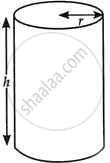
- Express ‘h’ in terms of ‘r’, using the given volume.
- Prove that the total surface area of the dustbin is `2πr^2 + (40π)/r`
- Sumit wants to paint the dustbin. The cost of painting the base and top of the dustbin is ₹ 2 per cm2 and the cost of painting the curved side is ₹ 25 per cm2. Find the total cost in terms of ‘r’, for painting the outer surface of the dustbin including the base and top.
- Calculate the minimum cost for painting the dustbin.
Advertisements
उत्तर
Given, radius of dustbin is r and height is h.
a. Volume of dustbin,
V = 20π cm3
Then, πr2h = 20π
`\implies` r2h = 20
`\implies` h = `20/r^2`
b. T.S.A. of dustbin = C.S.A + 2 base area
= 2πrh + 2πr2
= `2πr xx 20/r^2 + 2πr^2`
= `(40π)/r + 2πr^2`
= `2πr^2 + (40π)/r`
Hence proved
c. C.S.A. of dustbin = `(40π)/r cm^2`
Then, cost of painting (SA) = `(40π)/r xx 25`
= ₹ `(1000π)/r`
Base and top area of dustbin = 2πr2
Then, cost of painting (top and bottom)
= 2πr2 × 2
= ₹ 4πr2
Total cost of painting = ₹ `((1000π)/r + 4πr^2) `
d. Cost of painting,
C = `(1000π)/r + 4πr^2`
∴ `(dC)/(dr) = -(1000π)/r^2 + 8πr`
For minimum cost,
Put `(dC)/(dr)` = 0
`-(1000π)/r^2 + 8πr` = 0
`\implies` 8πr = `(1000π)/r^2`
`\implies` r3 = 125
`\implies` r = 5 cm
And `(d^2C)/(dr^2) = (2000π)/r^3 + 8π > 0`
Then, `(d^2C)/(dr^2)` is minimum for r = 5 cm.
Then, minimum cost of painting = `(1000π)/5 + 8π(5)`
= 200π + 40π
= ₹ 240π
