Advertisements
Advertisements
प्रश्न
Study the picture and answer the questions that follow.
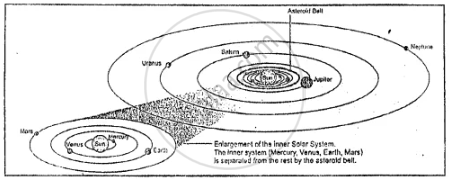
(a) What is meant by the Solar System?
(b) Give two differences between a planet and a star.
(c) Name the planets known as terrestrial planets.
(d) Give two advantages the earth has over other planets.
(e) What are satellites?
टीपा लिहा
Advertisements
उत्तर
(a) The sun along with eight planets and asteroids forms the Solar System.
(b)
- The stars like the sun radiate heat and light. Planets have no light of their own. They reflect the light of their stars.
- The stars are large burning masses very far from us while the planets are solid bodies nearer to us.
(c) The planets within the asteroids belt i.e. Mercury, Venus, Earth, and Mars, are called the Terrestrial planets.
(d)
- The earth enjoys an ideal average temperature of 17°C
- The earth consists of the life-system.
(e) The satellites are the celestial bodies that revolve around the planets.
shaalaa.com
या प्रश्नात किंवा उत्तरात काही त्रुटी आहे का?
