Advertisements
Advertisements
प्रश्न
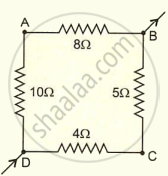
Study the figure carefully.
What is the equivalent resistance in the figure when the current enters at D and leaves at B?
संख्यात्मक
Advertisements
उत्तर
In the figure, current enters at D and leaves at B.
There are two paths between D and B.
Path 1: D-A-B (resistors in series)
\[ \mathrm{R}_{1} = 10 + 8 \]
\[ = 18 \ \Omega \]
Path 2: D-C-B (resistors in series)
\[ \mathrm{R}_{2} = 4 + 5 \]
\[ = 9 \ \Omega \]
These two paths are in parallel, so:
\[ \frac{1}{\mathrm{R}_{p}} = \frac{1}{\mathrm{R}_{1}} + \frac{1}{\mathrm{R}_{2}} \]
\[ = \frac{1}{18} + \frac{1}{9} \]
\[ = \frac{1 + 2}{18} \]
\[ = \frac{3}{18} \]
\[ = \frac{1}{6} \]
\[ \therefore \mathrm{R}_{p} = 6 \ \Omega \]
shaalaa.com
या प्रश्नात किंवा उत्तरात काही त्रुटी आहे का?
पाठ 7: Electric Circuits, Resistance and Ohm's Law - EXERCISE-2 [पृष्ठ १६०]
