Advertisements
Advertisements
प्रश्न
State your Opinion.
Indian agriculture was ruined completely as a result of British administration.
Advertisements
उत्तर
- The British government tried to introduce new land revenue systems like ‘Kayamdhara or Jamindari’ (permanent settlement), ‘Ryotwari’, and ‘Mahalwari’.
- These revenue systems were formed without any concern to the Indian tradition of revenue systems, the Indian cropping cycle, and the Indian climate.
- The new revenue systems introduced by the British made the common farmer penniless while making the government and the landlords rich.
- Earlier, the land tax could be paid by way of food grains and other commodities. Now the farmer had to pay it in hard cash. Despite of good or bad harvest, there was no option but to pay the tax.
- More so if there was a famine, the farmer was driven to a dire condition. Droughts, epidemics used to affect people and animals the most.
- However, the British outlook used to be absolutely unsympathetic. Thus, the farmer was caught between the government and moneylenders.
- Earlier, selling of agricultural land was not allowed. Now the British government defined agricultural land as sellable. The farmers who were in difficult situations had no alternative but to sell portions of their land, forgetting some hard cash.
- Lands thus acquired, were used for the cultivation of cash crops like indigo by the British owners. The labourers employed on their plants were exploited to the utmost. Their conditions were miserable. Unemployment, despair, disbelief loomed large all over India, which had made the life of common people very difficult.
Therefore, Indian agriculture was ruined completely as a result of British administration.
APPEARS IN
संबंधित प्रश्न
Write the name of the historical place /person/event.
The region of the regime of the parallel government established in 1942 -
______ was described the revolt of 1857 as First War of India Independence.
The Revolt of 1857 -
Who was the correspondent of the London Times who reported on the brutality of the 1857 revolt?
Who was Tantia Tope?
In 1858, the Royal Durbar was held at ______.
The ______ was the first major revolt of armed forces accompanied by civilian rebellion.
Lord Canning called the British army deputed to Germany by Britain to Calcutta.
Find the incorrect pair from every set and write the corrected one.
| Group ‘A’ | Group ‘B’ |
| 1. Anushilan Samiti | Aurobindo Ghosh |
| 2. Gadar | Lala Hardayal |
| 3. Hindustan socialist Republican Army | Chandrashekhar Azad |
| 4. Abhinav Bharat | Shyamji Krishna Verma |
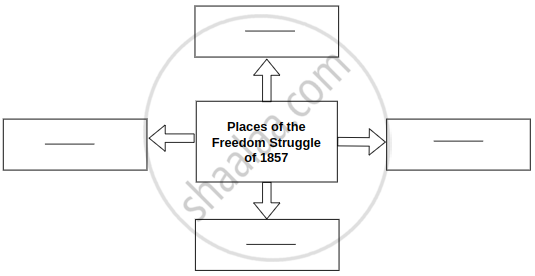
Complete the concept map.
Observe the given map and answer the questions based on it:
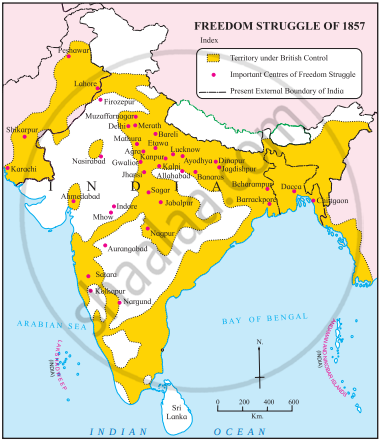
- To which topic is this map related?
- Name any one centre of the independence struggle of 1857 in present Bangladesh.
- Name any one centre of the independence struggle of 1857 in present Pakistan.
- Name any one place of the independence struggle of 1857 in present Maharashtra.
- Name the Indian island located in the Arabian Sea.
