Advertisements
Advertisements
प्रश्न
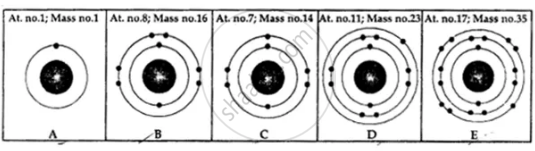
State the number of neutrons in each of the atoms A to E. Also state which of the atoms A to E is a metal.
Advertisements
उत्तर
Number of neutrons = A – Z
= Mass number – Atomic number
A. Number of neutrons =1 – 1 = 0
B. Number of neutrons = 16 – 8 = 8
C. Number of neutrons = 14 – 7 = 7
D. Number of neutrons = 23 – 11 = 12 (2, 8, 1 metal)
E. Number of neutrons = 35 – 17 = 18
APPEARS IN
संबंधित प्रश्न
Which subatomic particle is not present in an ordinary hydrogen atom?
Fill in the blank of the following statement :
If the nucleus of an atom has atomic number 17, mass number 37 and there are 17 electrons outside the nucleus, the number of neutrons in it is __________.
Explain in brief the experimental proof which led to the discovery of –
Neutrons
Identify the Mg2+ ion from the Fig. where, n and p represent the number of neutrons and protons respectively
Isotopes exist because atoms of the same element can have different numbers of ______.
What is the charge of a neutron?
Write the properties of neutrons.
The hydrogen atom does not have ______.
α, β, γ rays are during the ratio active decay ______ of an atom.
Beryllium + α – rays → Carbon + ______.
