Advertisements
Advertisements
प्रश्न
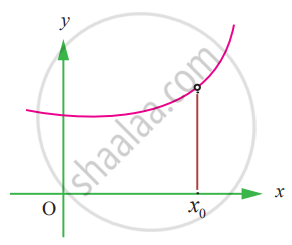
State how continuity is destroyed at x = x0 for the following graphs.
Advertisements
उत्तर
The function f(x) is not defined at x = x0 and hence the continuity is destroyed at x = x0
APPEARS IN
संबंधित प्रश्न
Prove that f(x) = 2x2 + 3x - 5 is continuous at all points in R
Examine the continuity of the following:
x + sin x
Examine the continuity of the following:
`(x^2 - 16)/(x + 4)`
Examine the continuity of the following:
|x + 2| + |x – 1|
Find the points of discontinuity of the function f, where `f(x) = {{:(x^3 - 3",", "if" x ≤ 2),(x^2 + 1",", "if" x < 2):}`
Show that the function `{{:((x^3 - 1)/(x - 1)",", "if" x ≠ 1),(3",", "if" x = 1):}` is continuous om `(- oo, oo)`
Which of the following functions f has a removable discontinuity at x = x0? If the discontinuity is removable, find a function g that agrees with f for x ≠ x0 and is continuous on R.
`f(x) = (x^2 - 2x - 8)/(x + 2), x_0` = – 2
Which of the following functions f has a removable discontinuity at x = x0? If the discontinuity is removable, find a function g that agrees with f for x ≠ x0 and is continuous on R.
`f(x) = (x^3 + 64)/(x + 4), x_0` = – 4
Find the constant b that makes g continuous on `(- oo, oo)`.
`g(x) = {{:(x^2 - "b"^2,"if" x < 4),("b"x + 20, "if" x ≥ 4):}`
Consider the function `f(x) = x sin pi/x`. What value must we give f(0) in order to make the function continuous everywhere?
The function `f(x) = (x^2 - 1)/(x^3 - 1)` is not defined at x = 1. What value must we give f(1) inorder to make f(x) continuous at x =1?
State how continuity is destroyed at x = x0 for the following graphs.
Choose the correct alternative:
Let the function f be defined by `f(x) = {{:(3x, 0 ≤ x ≤ 1),(-3 + 5, 1 < x ≤ 2):}`, then
Choose the correct alternative:
Let f : R → R be defined by `f(x) = {{:(x, x "is irrational"),(1 - x, x "is rational"):}` then f is
Choose the correct alternative:
Let f be a continuous function on [2, 5]. If f takes only rational values for all x and f(3) = 12, then f(4.5) is equal to
