Advertisements
Advertisements
प्रश्न
Solve the following numerical problem.
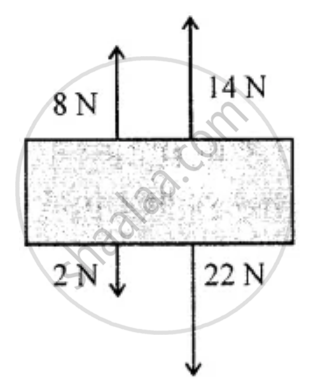
The forces acting on a wooden block are shown in the figure given alongside. Find the resultant of the forces and the direction of the resultant force.
Advertisements
उत्तर
Total forces acting downwards = 2 N + 22 N = 24 N
Total forces acting upwards = 8 N + 14 N = 22 N
Resultant force = Difference between the magnitude of forces = 24 N – 22 N = 2 N .
The wooden block will move in the downward direction with the resultant force of 2 N acting on it.
APPEARS IN
संबंधित प्रश्न
Write true or false.
The unit of weight is kilogram
Write true or false.
A force increases the mass of the body when applied on it.
Name the type of force which act in the following case:
A magnet attracts an iron pin
Define the term “weight of a body”
It is difficult to walk on a wet road. Explain.
Fill in the blank.
The force acting on a mango falling from a tree is an example of .....................
Answer the following in a word or two or in a sentence.
Name the force that is responsible for the falling of a stone from a height to the ground.
Solve the following numerical problem.
Two persons are pushing a car with a force of 30 N and 70 N in opposite directions. Calculate the resultant force and its direction.
State if the following statement is true or false. Correct the statement if it is false.
Friction wears down the parts of machi
Two women are of the same weight. One wears sandals with pointed heels while the other wears sandals with flat soles. Which one would feel more comfortable while walking on a sandy beach? Give reasons for your answer.
