Advertisements
Advertisements
प्रश्न
Show that the quadrilateral ABCD with vertices A(0, 3), B(–2, 0), C(0, –5) and D(2, 0) is a kite. Also, find the length of each diagonal of the kite ABCD.
Advertisements
उत्तर
1. Calculate side lengths
Using the distance formula `d = sqrt((x_2 - x_1)^2 + (y_2 - y_1)^2` for vertives A(0, 3), B(–2, 0), C(0, –5) and D(2, 0):
Side AB: `sqrt((-2 - 0)^2 + (0 - 3)^2`
= `sqrt(4 + 9)`
= `sqrt(13)`
Side AD: `sqrt((2 - 0)^2 + (0 - 3)^2`
= `sqrt(4 + 9)`
= `sqrt(13)`
Side BC: `sqrt((0 - (-2))^2 + (-5 - 0)^2`
= `sqrt(4 + 25)`
= `sqrt(29)`
Side CD: `sqrt((2 - 0)^2 + (0 - (-5))^2`
= `sqrt(4 + 25)`
= `sqrt(29)`
Since AB = AD and BC = CD, the quadrilateral has two pairs of equal adjacent sides, which is the definition of a kite.
2. Find lengths of diagonals
The diagonals are the segments connecting opposite vertices: AC and BD.
Diagonal AC: The distance between (0, 3) and (0, –5) is `sqrt((0 - 0)^2 + (-5 - 3)^2`
= `sqrt(64)`
= 8 units
Diagonal BD: The distance between (–2, 0) and (2, 0) is `sqrt((2 - (-2))^2 + (0 - 0)^2`
= `sqrt(16)`
= 4 units
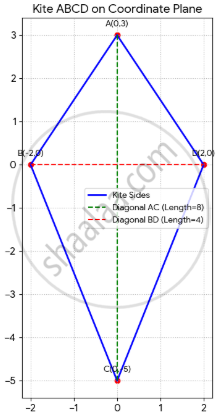
The quadrilateral ABCD is a kite because it has two pairs of equal adjacent sides (AB = AD = `sqrt(13)` and BC = CD = `sqrt(29)`). The length of diagonal AC is 8 units and the length of diagonal BD is 4 units.
