Advertisements
Advertisements
प्रश्न
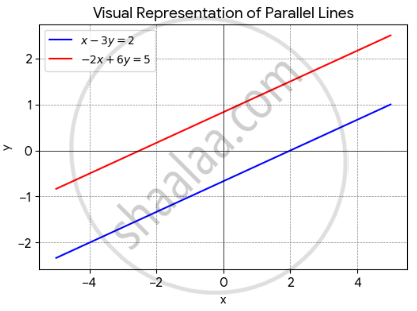
Show that the paths represented by the equations x – 3y = 2 and –2x + 6y = 5 are parallel.
Advertisements
उत्तर
1. Rearrange both equations
To find the slope of each path, convert the given linear equations into the slope-intercept form, which is given by y = mx + c where m is the slope and c is the y-intercept.
For the first path:
x – 3y = 2
–3y = –x + 2
`y = 1/3x - 2/3`
From this, the slope of the first line (m1) is `1/3`.
For the second path:
–2x + 6y = 5
6y = 2x + 5
`y = 2/6x + 5/6`
`y = 1/3x + 5/6`
From this, the slope of the second line (m2) is `1/3`.
2. Compare the properties
For two lines to be parallel, their slopes must be equal (m1 = m2) and their y-intercepts must be different (c1 ≠ c2).
`m_1 = 1/3` and `m_2 = 1/3`
⇒ m1 = m2
`c_1 = -2/3` and `c_2 = 5/6`
⇒ c1 ≠ c2
3. Alternative coefficient ratio check
Alternatively, we can write both equations in standard form ax + by + c = 0:
1. 1x – 3y – 2 = 0
⇒ a1 = 1, b1 = –3, c1 = –2
2. –2x + 6y – 5 = 0
⇒ a2 = –2, b2 = 6, c2 = –5
Now, find the ratios of their coefficients:
`(a_1)/(a_2) = 1/(-2) = -1/2`
`(b_1)/(b_2) = (-3)/(6) = -1/2`
`(c_1)/(c_2) = (-2)/(-5) = 2/2`
Since `(a_1)/(a_2) = (b_1)/(b_2) ≠ (c_1)/(c_2)`, the lines are mathematically proven to be parallel with no shared points of intersection.