Advertisements
Advertisements
प्रश्न
Show that `lim_("n" -> oo) 1/1.2 + 1/2.3 + 1/3.4 + ... + 1/("n"("n" + 1))` = 1
Advertisements
उत्तर
Tn = `1/("n"("n" + 1))`
`1/("n"("n" + 1)) = "A"/"n" + "B"/("n" +1)`
1 = A(n + 1) + Bn
Put n = 0
1 = A(0 + 1) + B × 0
A = 1
Put n = – 1
1 = A(– 1 + 1) + B(– 1)
1 = 0 – B
⇒ B = – 1
`1/("n"("n" + 1)) = 1/"n" - 1/("n" + 1)`
Tn = `1/"n" - 1/("n" + 1)`
T1 = `1/1- 1/2`
T2 = `1/2 - 1/3`
T3 = `1/3 - 1/4`
........................
........................
Tn = `1/"n" - 1/("n" + 1)`
T1 + T2 + .... + Tn = `(1/1 - 1/2) + (1/2 - 1/3) + (1/3 - 1/4) + .... + (1/"n" - 1/("n" + 1))`
T1 + T2 + .... + Tn = `(1 - 1/("n" + 1))`
`lim_("n" -> oo) ("T"_1 + "T"_2 + .... + "T"_"n") = lim_("n" -> oo) (1 - 1/("n" + 1))`
= `1 - lim_("n" -> oo) 1/("n" + 1)`
= 1 – 0
`lim_("n" -> oo) 1/1.2 + 1/2.3 + 1/3.4 + ... + 1/("n"("n" + 1))` = 1
APPEARS IN
संबंधित प्रश्न
Evaluate the following limit :
`lim_(x -> 7)[((root(3)(x) - root(3)(7))(root(3)(x) + root(3)(7)))/(x - 7)]`
Evaluate the following limit :
`lim_(z -> "a")[((z + 2)^(3/2) - ("a" + 2)^(3/2))/(z - "a")]`
In problems 1 – 6, using the table estimate the value of the limit
`lim_(x -> 2) (x - 2)/(x^2 - 4)`
| x | 1.9 | 1.99 | 1.999 | 2.001 | 2.01 | 2.1 |
| f(x) | 0.25641 | 0.25062 | 0.250062 | 0.24993 | 0.24937 | 0.24390 |
In problems 1 – 6, using the table estimate the value of the limit
`lim_(x -> 0) (sqrt(x + 3) - sqrt(3))/x`
| x | – 0.1 | – 0.01 | – 0.001 | 0.001 | 0.01 | 0.1 |
| f(x) | 0.2911 | 0.2891 | 0.2886 | 0.2886 | 0.2885 | 0.28631 |
In problems 1 – 6, using the table estimate the value of the limit
`lim_(x -> - 3) (sqrt(1 - x) - 2)/(x + 3)`
| x | – 3.1 | – 3.01 | – 3.00 | – 2.999 | – 2.99 | – 2.9 |
| f(x) | – 0.24845 | – 0.24984 | – 0.24998 | – 0.25001 | – 0.25015 | – 0.25158 |
In problems 1 – 6, using the table estimate the value of the limit
`lim_(x -> 0) (cos x - 1)/x`
| x | – 0.1 | – 0.01 | – 0.001 | 0.0001 | 0.01 | 0.1 |
| f(x) | 0.04995 | 0.0049999 | 0.0004999 | – 0.0004999 | – 0.004999 | – 0.04995 |
In exercise problems 7 – 15, use the graph to find the limits (if it exists). If the limit does not exist, explain why?
`lim_(x -> 0) sec x`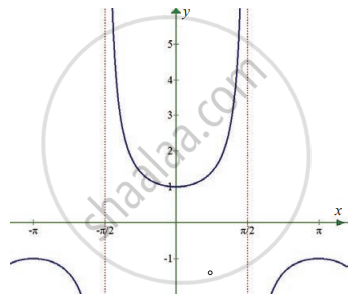
Evaluate the following limits:
`lim_(x -> 0) (sqrt(1 + x) - 1)/x`
Evaluate the following limits:
`lim_(x -> 0) (sqrt(1 - x) - 1)/x^2`
Evaluate the following limits:
`lim_(x ->oo) (x^3/(2x^2 - 1) - x^2/(2x + 1))`
Evaluate the following limits:
`lim_(x -> oo) (1 + 3/x)^(x + 2)`
Evaluate the following limits:
`lim_(x -> 0) (sin^3(x/2))/x^2`
Evaluate the following limits:
`lim_(x -> 0) (2^x - 3^x)/x`
Choose the correct alternative:
`lim_(theta -> 0) (sinsqrt(theta))/(sqrt(sin theta)`
Choose the correct alternative:
`lim_(x - oo) sqrt(x^2 - 1)/(2x + 1)` =
Choose the correct alternative:
`lim_(x -> 3) [x]` =
Choose the correct alternative:
The value of `lim_(x -> 0) sinx/sqrt(x^2)` is
