Advertisements
Advertisements
प्रश्न
Short Answer Question.
Explain the chromosomal theory of inheritance.
Advertisements
उत्तर
The chromosomal theory of inheritance was proposed by Sutton and Boveri.
Following are the postulates of chromosomal theory of inheritance:
- Chromosomes are found in pairs in somatic or diploid cells.
- During gamete formation, homologous chromosomes pair, segregate and assort independently at meiosis. Due to this, each gamete contains only one chromosome of a pair.
- Hereditary characters are carried by chromosomes which are present in the nucleus of these gametes.
- Gametes (sperm and egg) contain all the hereditary characters. They form the link between parents and offsprings.
- The union of sperm and egg during fertilization restores the diploid number of chromosomes.
APPEARS IN
संबंधित प्रश्न
If the number of chromosomes in an endosperm cell is 27, what will be the chromosome number in the definitive nucleus?
- 9
- 18
- 27
- 36
How many chromosomes do drones of honey bees possess?
Explain the types of chromosomes on the basis of position of centromere.
Choose the correct options of the following question:
Study the given monohybrid cross:
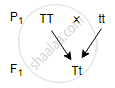
A test cross for this Fj will be:
Give an account of artificial chromosomes in the transfer of genetic material.
In a certain taxon of insects some have 17 chromosomes and the others have 18 chromosomes. The 17 and 18 chromosome-bearing organisms are ______.
Which of the following statements indicates parallelism in genes and chromosomes?
- They occur in pairs.
- They segregate during gamete formation.
- They show linkage.
- Independent pairs segregate independently.
Which chromosome in the human genome has the highest number of genes?
Which scientist provided the first experimental proof of the Chromosomal Theory of Inheritance using Drosophila melanogaster?
How many scientists independently rediscovered Mendel's laws of inheritance in the year 1900?
