Advertisements
Advertisements
प्रश्न
Advertisements
उत्तर
The substance's rate of decay and the type of radiation it emits are unaffected by any physical or chemical changes, including variations in temperature and pressure, extreme heating, freezing, the effect of strong electric and magnetic fields, chemical treatment, oxidation, etc.
This demonstrates unequivocally that the orbital electrons, which are susceptible to such alterations, cannot be the cause of the radioactive event. Thus, the nucleus should be the source of radioactivity. The phenomenon of radioactivity is thus nuclear.
संबंधित प्रश्न
State three factors on which the rate of emission of electrons from a metal surface depends
An element `""_ZS^A` decays to `""_85R^222` after emitting 2 α particles and 1 β particle.
Find the atomic number and atomic mass of the element S.
Name a gas caused by the Greenhouse effect
Radiations given out from a source when subjected to an electric field in a direction perpendicular to their path are shown below in the diagram. The arrows show the path of the radiation A, B and C. Answer the following questions in terms of A, B and C.
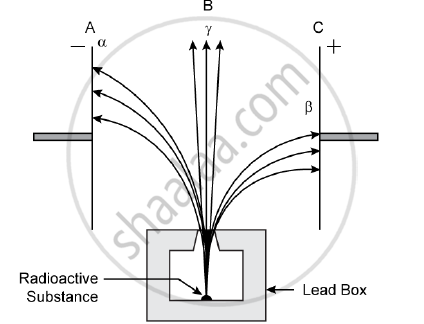
1) Name the radiation B which is unaffected by the electrostatic field.
2) Why does the radiation C deflect more than A?
3) Which among the three causes the least biological damage externally.
4) Name the radiation which is used in carbon dating.
Give a scientific explanation.
When the radiation coming out from a certain radioactive substance is passed through an electric field, marks are found at three places on the photographic plate placed in its path.
What happens to the mass number of an element when (i) an α -particle, (ii) a β -particle, and (iii) γ -radiation is emitted?
Radioactive substances were found to give off three types of rays. Name them. How do they
(a) React to the magnetic field?
(b) React to the electric field?
(c) Act when different thickness of lead sheets is placed in their path?
In a cathode ray tube state the purpose of covering cathode by thorium and carbon.
Two radioactive sources A and B of half lives of 1 hour and 2 hours, respectively, initially contain the same number of radioactive atoms. At the end of two hours, their rates of disintegration are in the ratio of ______.
Assertion (A): The force of repulsion between atomic nucleus and α-particle varies with distance according to inverse square law.
Reason (R): Rutherford did α-particles scattering experiment.
