Advertisements
Advertisements
प्रश्न
Prove the following identities:
`((1 + tan^2A)cotA)/(cosec^2A) = tan A`
Advertisements
उत्तर
L.H.S. = `((1 + tan^2A)cotA)/(cosec^2A)`
= `(sec^2A cotA)/(cosec^2A` ...(∵ sec2 A = 1 + tan2 A)
= `(1/(cos^2A) xx (cosA)/(sinA))/(1/(sin^2A))`
= `(1/(cosA sinA))/(1/(sin^2A))`
= `sinA/cosA`
= tan A = R.H.S.
APPEARS IN
संबंधित प्रश्न
Prove the following identities:
sec2A + cosec2A = sec2A . cosec2A
If 2 sin A – 1 = 0, show that: sin 3A = 3 sin A – 4 sin3 A
`sqrt((1-cos theta)/(1+cos theta)) = (cosec theta - cot theta)`
If `sin theta = x , " write the value of cot "theta .`
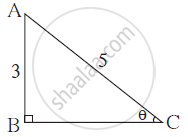
From the figure find the value of sinθ.
Prove the following identity :
secA(1 - sinA)(secA + tanA) = 1
Without using trigonometric table , evaluate :
`cos90^circ + sin30^circ tan45^circ cos^2 45^circ`
Prove that `[(1 + sin theta - cos theta)/(1 + sin theta + cos theta)]^2 = (1 - cos theta)/(1 + cos theta)`
Which is not correct formula?
If `sqrt(3) tan θ` = 1, then find the value of sin2θ – cos2θ.
