Advertisements
Advertisements
प्रश्न
Prove that the diagonals of a kite intersect each other at right angles.
Advertisements
उत्तर
Consider ABCD is a kite.
Then, AB = AD and BC = DC
In ΔABC and ΔADC,
AB = AD
BC = CD
AC = AC
∴ ΔABC ≅ ΔADC ...(SSS Congruence)
⇒ ∠BCA = ∠DCA ...(C.P.C.T)
⇒ ∠BCO = ∠DCO ...(i)
Now,
In ΔOBC and ΔODC,
BC = CD
∠BCO = ∠DCO ...[From (i)]
OC = OC ...(common)
∴ ΔOBC ≅ ΔODC ...(SAS congruence)
∠COB - ∠COD ...(C. C.T)
But, ∠COB + ∠CID = 180° ...(Linear pair)
⇒ ∠COB + ∠COB = 180°
⇒ 2∠COB = 180°
⇒ ∠COB = 90°
Hence, diagonals f a kite intersect each other at right angles.
संबंधित प्रश्न
ABCD is a parallelogram. P and Q are mid-points of AB and CD. Prove that APCQ is also a parallelogram.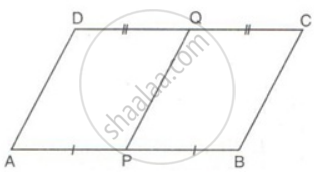
SN and QM are perpendiculars to the diagonal PR of parallelogram PQRS.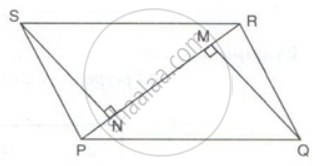
Prove that:
(i) ΔSNR ≅ ΔQMP
(ii) SN = QM
PQRS is a parallelogram. PQ is produced to T so that PQ = QT. Prove that PQ = QT. Prove that ST bisects QR.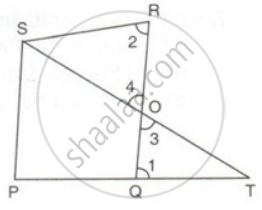
Prove that if the diagonals of a parallelogram are equal then it is a rectangle.
Prove that the line segment joining the mid-points of the diagonals of a trapezium is parallel to each of the parallel sides, and is equal to half the difference of these sides.
In a parallelogram PQRS, M and N are the midpoints of the opposite sides PQ and RS respectively. Prove that
PMRN is a parallelogram.
In a parallelogram PQRS, M and N are the midpoints of the opposite sides PQ and RS respectively. Prove that
MN bisects QS.
Prove that the diagonals of a parallelogram divide it into four triangles of equal area.
In ΔPQR, PS is a median. T is the mid-point of SR and M is the mid-point of PT. Prove that: ΔPMR = `(1)/(8)Δ"PQR"`.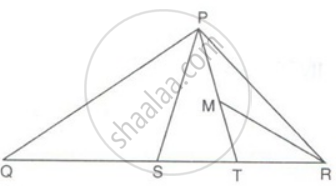
The medians QM and RN of ΔPQR intersect at O. Prove that: area of ΔROQ = area of quadrilateral PMON.
