Advertisements
Advertisements
प्रश्न
Prove that if a line is drawn parallel to one side of a triangle to intersect the other two sides in distinct points, the other two sides are divided in the same ratio.
Hence in ΔPQR, prove that a line ℓ intersects the sides PQ and PR of a ∆PQR at L and M, respectively, such that LM || QR. If PL = 5.7 cm, PQ = 15.2 cm and MR = 5.5 cm, then find the length of PM (in cm).
Advertisements
उत्तर

Given:
ΔABC where DE || BC
To prove:
`(AD)/(DB) = (AE)/(EC)`
Construction:
Join BE and CD.
Draw DM ⊥ AC and EN ⊥ AB.
Proof:
`(ar(ADE))/(ar(BDE)) = (1/2 xx AD xx EN)/(1/2 xx DB xx EN)`
`(ar(ADE))/(ar(BDE)) = (AD)/(DB)` ...(i)
`(ar(ADE))/(ar(DEC)) = (1/2 xx AE xx DM)/(1/2 xx EC xx DM)`
`(ar(ADE))/(ar(DEC)) = (AE)/(EC)` ...(ii)
Now, ΔBDE and ΔDEC are on the same base DE and between the same parallel lines BC and DE.
∴ ar(BDE) = ar(DEC)
Hence, `(ar(ADE))/(ar(BDE)) = (ar(ADE))/(ar(DEC))`
`(AD)/(DB) = (AE)/(EC)` ...[From equation (i) and (ii)]
Hence proved.
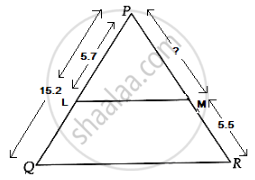
If a line is drawn parallel to one side of a triangle to intersect the other two sides in distinct points, the other two sides are divided in the same ratio.
`(PL)/(LQ) = (PM)/(MR)`
`(PL)/(PQ - PL) = (PM)/(MR)`
`5.7/(15.2 - 5.7) = (PM)/5.5`
`5.7/9.5 = (PM)/5.5`
PM × 9.5 = 5.7 × 5.5
PM = `(5.7 xx 5.5)/9.5`
= `62.7/19`
= 3.3 cm
