Advertisements
Advertisements
प्रश्न
Picture based question
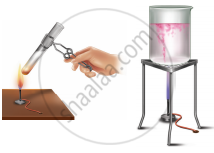
Arul and Aakash were doing an experiment in which water was to be heated in a beaker. Arul kept the beaker near the wick in the yellow part of candle flame. Aakash kept the beaker in the outer most part to the flame. Whose water will get heated in a shorter time?
Advertisements
उत्तर
The water heated by Akash will get heated in a shorter time because he kept his beaker near the hottest (non- luminous) zone of the flame. But Arul kept the beaker in the luminous zone which is moderately hot. So, it will take longer time.
APPEARS IN
संबंधित प्रश्न
Make a labelled diagram of a candle flame.
Magnesium ribbon on burning in air produces
The substance that does not burn with flame is ______.
On placing an inverted tumbler over a burning candle, the flame extinguishes after some time. This is because of non-availability of
The ______ temperature at which a substance catches fire is called its ______ temperature.
Anu wants to boil water quickly in a test tube. On observing the different zones of the flame, she is not able to decide which zone of the flame will be best for boiling water quickly. Help her in this activity.
Substances which vapourise during burning produce ______.
Match the following:
| 1. | White flame | a. | Table salt |
| 2. | Indigo flame | b. | Bleaching powder |
| 3. | Blue flame | c. | Potassium chloride |
| 4. | Orange flame | d. | Epsom salt |
Match the following:
| 1. | Inner zone | a. | Yellow |
| 2. | Outer zone | b. | Borax powder |
| 3. | Middle zone | c. | Blue |
| 4. | Green flame | d. | Black |
Explain the structure of a candle flame.
