Advertisements
Advertisements
प्रश्न
P and Q are respectively the mid-points of sides AB and BC of a triangle ABC and R is the mid-point of AP, show that
(i) ar(PRQ) = 1/2 ar(ARC)
(ii) ar(RQC) = 3/8 ar(ABC)
(iii) ar(PBQ) = ar(ARC)
Advertisements
उत्तर
Take a point S on AC such that S is the mid-point of AC.
Extend PQ to T such that PQ = QT.
Join TC, QS, PS, and AQ.
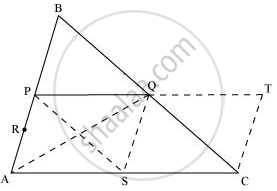
In ΔABC, P and Q are the mid-points of AB and BC respectively. Hence, by using mid-point theorem, we obtain
PQ || AC and PQ = 1/2AC
⇒ PQ || AS and PQ = AS (As S is the mid-point of AC)
∴ PQSA is a parallelogram. We know that diagonals of a parallelogram bisect it into equal areas of triangles.
∴ ar (ΔPAS) = ar (ΔSQP) = ar (ΔPAQ) = ar (ΔSQA)
Similarly, it can also be proved that quadrilaterals PSCQ, QSCT, and PSQB are also parallelograms and therefore,
ar (ΔPSQ) = ar (ΔCQS) (For parallelogram PSCQ)
ar (ΔQSC) = ar (ΔCTQ) (For parallelogram QSCT)
ar (ΔPSQ) = ar (ΔQBP) (For parallelogram PSQB)
Thus,
ar (ΔPAS) = ar (ΔSQP) = ar (ΔPAQ) = ar (ΔSQA) = ar (ΔQSC) = ar (ΔCTQ) = ar (ΔQBP) ... (1)
Also, ar (ΔABC) = ar (ΔPBQ) + ar (ΔPAS) + ar (ΔPQS) + ar (ΔQSC)
ar (ΔABC) = ar (ΔPBQ) + ar (ΔPBQ) + ar (ΔPBQ) + ar (ΔPBQ)
= 4 ar (ΔPBQ)
⇒ ar (ΔPBQ) = 1/4 ar(ΔABC) ... (2)
(i)Join point P to C.
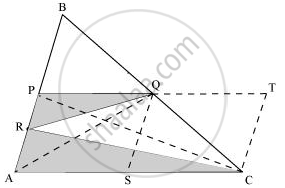
In ΔPAQ, QR is the median.
`therefore ar(trianglePRQ)=1/2ar(trianglePAQ)=1/2xx1/4ar(triangleABC)=1/8ar(triangleABC)" .........(3)"`
In ΔABC, P and Q are the mid-points of AB and BC respectively. Hence, by using mid-point theorem, we obtain
PQ = 1/2AC
AC = 2PQ ⇒ AC = PT
Also, PQ || AC ⇒ PT || AC
Hence, PACT is a parallelogram.
ar (PACT) = ar (PACQ) + ar (ΔQTC)
= ar (PACQ) + ar (ΔPBQ [Using equation (1)]
∴ ar (PACT) = ar (ΔABC) ... (4)
`ar(triangleARC) = 1/2ar(trianglePAC)" (CR is the median of ΔPAC)"`
`= 1/2xx1/2ar(PACT)" (PC is the diagonal parallelogram PACT)"`
`= 1/4 ar(PACT) = 1/4 ar(triangleABC)`
`rArr 1/2ar(triangleARC) = 1/8ar(triangleABC)`
`rArr1/2ar(triangleARC)=ar(trianglePRQ)" [Using equation (3)] .......(5)"`
(ii)
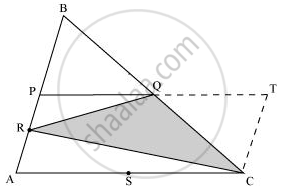
ar(PACT) = ar(ΔPRQ) + ar(ΔARC) + ar(ΔQTC) + ar(ΔRQC)
Putting the values from equations (1), (2), (3), (4), and (5), we obtain
`ar(ΔABC) = 1/8ar(ΔABC) + 1/4ar(ΔABC) + 1/4ar(ΔABC) + ar(ΔRQC)`
`ar(ΔABC) = 5/8ar(ΔABC) + ar(ΔRQC)`
`ar(ΔRQC) = (1-5/8)ar(ΔABC)`
`ar(ΔRQC) = 3/8ar(ΔABC)`
(iii) In parallelogram PACT,
`ar(ΔARC) = 1/2ar(ΔPAC)" (CR is the median of ΔPAC)"`
`= 1/2xx1/2ar(PACT)" (PC is the diagonal of parallelogram PACT)"`
`= 1/4ar(PACT)`
`= 1/4ar(ABC)`
= ar(ΔPBQ)
संबंधित प्रश्न
D, E and F are respectively the mid-points of the sides BC, CA and AB of a ΔABC. Show that
(i) BDEF is a parallelogram.
(ii) ar (DEF) = 1/4ar (ABC)
(iii) ar (BDEF) = 1/2ar (ABC)
In the given figure, diagonals AC and BD of quadrilateral ABCD intersect at O such that OB = OD. If AB = CD, then show that:
(i) ar (DOC) = ar (AOB)
(ii) ar (DCB) = ar (ACB)
(iii) DA || CB or ABCD is a parallelogram.
[Hint: From D and B, draw perpendiculars to AC.]

D and E are points on sides AB and AC respectively of ΔABC such that
ar (DBC) = ar (EBC). Prove that DE || BC.
Diagonals AC and BD of a trapezium ABCD with AB || DC intersect each other at O. Prove that ar (AOD) = ar (BOC).
In the following figure, ABC is a right triangle right angled at A. BCED, ACFG and ABMN are squares on the sides BC, CA and AB respectively. Line segment AX ⊥ DE meets BC at Y. Show that:-

(i) ΔMBC ≅ ΔABD
(ii) ar (BYXD) = 2 ar(MBC)
(iii) ar (BYXD) = ar(ABMN)
(iv) ΔFCB ≅ ΔACE
(v) ar(CYXE) = 2 ar(FCB)
(vi) ar (CYXE) = ar(ACFG)
(vii) ar (BCED) = ar(ABMN) + ar(ACFG)
Note : Result (vii) is the famous Theorem of Pythagoras. You shall learn a simpler proof of this theorem in Class X.
X and Y are points on the side LN of the triangle LMN such that LX = XY = YN. Through X, a line is drawn parallel to LM to meet MN at Z (See figure). Prove that ar (LZY) = ar (MZYX)
The area of the parallelogram ABCD is 90 cm2 (see figure). Find ar (ΔABD)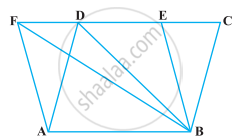
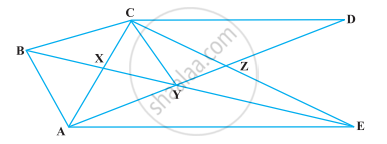
In the following figure, CD || AE and CY || BA. Prove that ar (CBX) = ar (AXY).
If the medians of a ∆ABC intersect at G, show that ar (AGB) = ar (AGC) = ar (BGC) = `1/3` ar (ABC)
In the following figure, X and Y are the mid-points of AC and AB respectively, QP || BC and CYQ and BXP are straight lines. Prove that ar (ABP) = ar (ACQ).

