Advertisements
Advertisements
प्रश्न
On whom did Mr Wonka tested the oily black liquid?
Advertisements
उत्तर
Mr Wonka tested the oily black liquid over an Oompa-Loompa volunteer.
संबंधित प्रश्न
The poem is about a brook. A dictionary would define a brook, as a stream or a
small river. Read the poem silently first. After the first reading, the teacher will
make you listen to a recording of the poem. What do you think the poem is all
about?
I come from haunts of coot and hern;
I make a sudden sally
And sparkle out among the fern,
To bicker down a valley.
By thirty hills I hurry down,
Or slip between the ridges,
By twenty thorpes, a little town,
And half a hundred bridges.
Till last by Philip's farm I flow
10 To join the brimming river,
For men may come and men may go,
But I go on for ever.
I chatter over stony ways,
In little sharps and trebles,
15 I bubble into eddying bays,
I babble on the pebbles.
With many a curve my banks I fret
By many a field and fallow,
And many a fairy foreland set
20 With willow-weed and mallow.
I chatter, chatter, as I flow
To join the brimming river,
For men may come and men may go,
But I go on for ever.
25 I wind about, and in and out,
With here a blossom sailing,
And here and there a lusty trout,
And here and there a grayling,
And here and there a foamy flake
30 Upon me, as I travel
With many a silvery waterbreak
Above the golden gravel,
And draw them all along, and flow
To join the brimming river
35 For men may come and men may go,
But I go on for ever.
I steal by lawns and grassy plots,
I slide by hazel covers
I move the sweet forget-me-nots
40 That grow for happy lovers.
I slip, I slide, I gloom, I glance,
Among my skimming swallows;
I make the netted sunbeam dance
Against my sandy shallows.
45 I murmur under moon and stars
In brambly wildernesses;
I linger by my shingly bars;
I loiter round my cresses;
And out again I curve and flow
50 To join the brimming river,
For men may come and men may go,
But I go on for ever.
About the Poet
Lord Tennyson (1809-92) was born in Lincolnshire. Poet Laureate for over 40 years, Tennyson is representative of the Victorian age. His skilled craftsmanship and noble ideals retained a large audience for poetry in an age when the novel was engrossing more and more readers. Tennyson's real contribution lies in his shorter poems like The Lady of Shallot, The Princess, Ulysses, The Palace of Art etc. His fame rests on his perfect control of sound, the synthesis of sound and meaning, and the union of visual and musical.
Read the following story
There lived a wise old man in Purkul, Dehradun. The villagers looked up to him and approached him for all their problems. Three naughty boys Amar, Naveen and Praveen wanted to test the old man's wisdom. One fine morning they caught a butterfly while playing in the garden. Amar had the
butterfly in his hand. He said, "We will go to the old man and ask him ifthe butterfly is dead or alive. If the old man says, 'the butterfly is dead', I will open my hands and release the butterfly. It will fly away." "If he says it is alive?" asked N aveen looking at Amar with a smirk. "I will crush the butterfly and show him the dead insect," said Amar. The three of them set forth with their wonderful plan.
Amar went to the old man and said, "Sir, the villagers say you can predict the future. Now tell us if the butterfly in my hand is dead or alive?" The old man looked at the three boys with a serene smile and said, "It is in your hands."
Now, it is your turn. Write and produce your own radio programme. You will need to select your own content. The following are some ideas. You are free, of course, to add your own ideas. Remember, the programme must be in English.
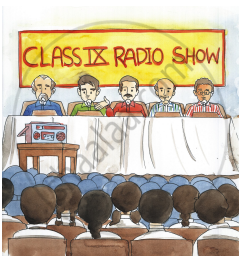
- News stories: about people in your class, about school, about sports (school and local), about the local community
- Comedy: jokes, short plays
- Interviews: with teachers, with exstudents of your school, with a Class IX student who has recently done something very interesting
- Games: general knowledge quiz, panel game, word game
- Advertisements: for shops/industries in the local community, things ‘for sale’ and ‘wanted’ by students
- Local sites: monuments/sites of historical importance and of tourist interest
- Special reports: e.g. safety at school, examination results, school uniform, school assemblies
- Interesting people: role-play interviews with film stars, sports personalities, TV personalities, etc.
- Entertainment reviews: music, films, videos, books, etc.
- Plays
- Songs with lyrics
- Speeches on important personalities
- Tele conference video conference with students, teachers, experts
Old Kaspar took it from the boy,
Who stood expectant by;
And then the old man shook his head,
And,with a natural sigh,
"Tis some poor fellow's skull," said he,
"Who fell in the great victory.
"I find them in the garden,
For there's many here about;
And often when I go to plough,
The ploughshare turns them out!
For many thousand men,"said he,
"Were slain in that great victory."
Read the lines given above and answer the question that follow.
What does the tone of Kasper’s words suggest?
“There were three animals altogether,” he explained. “There were two goats and a cat and then there were four pairs of pigeons.”
“And you had to leave them?” I asked.
“Yes. Because of the artillery. The captain told me to go because of the artillery.” “And you have no family?” I asked, watching the far end of the bridge where a few last carts were hurrying down the slope of the bank.
“No,” he said, “only the animals I stated. The cat, of course, will be all right. A cat can look out for itself, but I cannot think what will become of the others.”
“What politics have you?” I asked.
“I am without politics,” he said. “I am seventy-six years old. I have come twelve kilometers now and I think now I can go no further.”
“This is not a good place to stop,” I said. “If you can make it, there are trucks up the road where it forks for Tortosa.”
“I will wait a while,” he said, “ and then I will go. Where do the trucks go?” “Towards Barcelona,” I told him.
“I know no one in that direction,” he said, “but thank you very much.
Read the extract given below and answer the question that follow.
Why did the old man have to leave his animals?
Then, trying to hide my nervousness, I added, “How are you?”
“I’m fine. The question is: How are you?“
“What do you mean?” 1 asked “Something must be eating you,” he said—proud the way foreigners are when they’ve mastered a bit of American slang. “You should be able to qualify with your eyes closed.”
“Believe me, I know it,” I told him—and it felt good to say that to someone.
For the next few minutes we talked together. I didn’t tell Long what was “eating” me, but he seemed to understand my anger, and he took pains to reassure me. Although he’d been schooled in the Nazi youth movement, he didn’t believe in the Aryan-supremacy business any more than I did. We laughed over the fact that he really looked the part, though. An inch taller than I, he had a lean, muscular frame, clear blue eyes, blond hair and a strikingly handsome, chiseled face. Finally, seeing that I had calmed down somewhat, he pointed to the take-off board.
“Look,” he said. “Why don’t you draw a line a few inches in back of the board and aim at making your take-off from there? You’ll be sure not to foul, and you certainly ought to jump far enough to qualify. What does it matter if you’re not first in the trials? Tomorrow is what counts.”
Read the extract given below and answer the question that follow.
How did Owens manage to qualify for the finals with a foot to spare?
Answer the following question.
“We have orders to let them shout”.What is the policeman referring to?
How have we learnt to control fire?
What is in general, the relationship between a mongoose and a snake?
What message did the old clocks spread as they chimed ‘Merry Christmas’ together?
What was the connection between the motor and the fan’s Chatter?
From where did the narrator’s father get the ladder?
Find words in the story, which show things striking violently against each other.
The birds dived at the snake, but b____d into each other instead.
The words given against the sentences below can be used both as nouns and verbs. Use them appropriately to fill in the blanks.
(i) He said he _________________________ to be invited to the party. (hope)
(ii) We gave up _______________________ of his joining the party.
Use the word, ‘run’ in a sentence of your own.
Why does the speaker say that “there isn’t anyone staring or making strange noises”?
Add im- or in- to each of the following words and use them in place of the italicised words in the sentences given below.
| patient, proper, possible, sensitive, competent |
That’s not a proper remark to make under the circumstances.
Do you think Mr Gessler was a failure as a bootmaker or as a competitive businessman?
|
Antonio: |
(Aside to Sebastian) Let it be tonight; |
What does Antonio refer to when he says “Let it be tonight...” in Act III, Scene iii of the play, The Tempest?
Choose the option that lists the sequence of events from Alphonse Daudet’s short story ‘The Last Lesson’ in the correct order.
- But, when he arrived at school, Franz was dismayed to find his classmates already seated quietly and solemnly in their places ... and shocked when M. Hamel simply urged him to take his place.
- Franz hurried to school that morning he was very late and dreaded being scolded by M. Hamel, the teacher.
- After he had settled at his desk, he noticed something really odd: the back benches of the classroom were occupied by adults from the village!
- He hoped to slip into the classroom unnoticed, under cover of the bustle and noise of a typical school day morning.
