Advertisements
Advertisements
प्रश्न
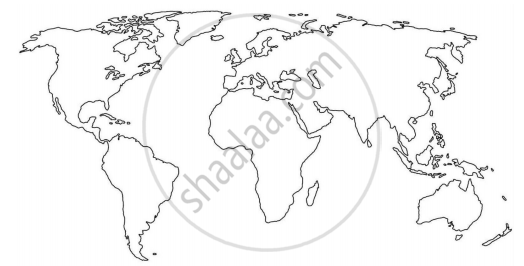
On an outline map of the world, mark the Pacific Ring of Fire
Advertisements
उत्तर

APPEARS IN
संबंधित प्रश्न
Give reasons why an earthquake occurs.
Fill in the blank:
___________ are the first earthquake waves to be recorded on a seismograph of an earthquake.
Fill in the blank:
The last of the earthquake waves to arrive on the surface of the earth are ___________ waves.
Fill in the blank:
The giant sea waves caused by earthquakes in the oceans are called ___________.
What is called an earthquake?
What are known as seismic focus and epicenter with respect to an earthquake?
How is the intensity of an earthquake measured?
How an earthquake is caused?
Earthquakes occur in the Mid-Atlantic belt.
Name three causes of Earthquakes.
Give one word for the following :
An instrument used for recording all the earth tremors and earthquakes.
Give one word for the following :
The surface position immediately above the origin of an earthquake.
The magnitude of an earthquake is measured by ______.
Define Earthquake.
What is Seismograph?
Give a note on Tsunami 2004.
In India, the Himalayan region and the ______ valley are prone to earthquakes.
Name the point where the vibrations originate in an earthquake.
