Advertisements
Advertisements
प्रश्न
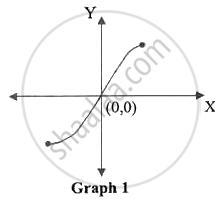
Observe the two graphs, Graph 1 and Graph 2 given below and answer the questions that follow.
 |
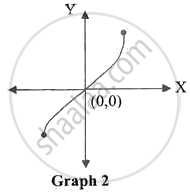 |
(i) Which one of the graphs represents y = sin–1x? [1]
(ii) Write the domain and range of y = sin–1x. [1]
(iii) Prove that `sin^-1 1/sqrt(5) + sin^-1 2/sqrt(5) = π/2` [2]
(iv) Find the value of `tan^-1 [2sin (2 cos^-1 sqrt(3)/2)]` [2]
Advertisements
उत्तर
(i) Graph (1) represents y = sin–1x.
(ii) Domain of sin–1x is [–1, 1].
Range = `[(-π)/2, π/2]`
(iii) We know
`sin^-1x + sin^-1y = sin^-1 [xsqrt(1 - y^2) + ysqrt(1 - x^2)]`
∴ `sin^-1 1/sqrt(5) + sin^-1 2/sqrt(5)`
= `sin^-1 [1/sqrt(5) sqrt(1 - 4/5) + 2/sqrt(5) sqrt(1 - 1/5)]`
= `sin^-1 [1/sqrt(5) xx 1/sqrt(5) + 2/sqrt(5) xx 2/sqrt(5)]`
= `sin^-1 (1/5 + 4/5)`
= sin–1 (1)
= `π/2`
∴ `sin^-1 1/sqrt(5) + sin^-1 2/sqrt(5) = π/2`
Hence Proved.
(iv) `tan^-1 [2sin (2cos^-1 sqrt(3)/2)]`
⇒ `tan^-1 [2sin (2 xx π/6)]`
⇒ `tan^-1 [2sin π/3]`
⇒ `tan^-1 (2 xx sqrt(3)/2)`
⇒ `tan^-1 (sqrt(3))`
⇒ `π/3`
