Advertisements
Advertisements
प्रश्न
Name the mirror which forms an erect, virtual and enlarged image of an object. What is the position of object relative to the mirror?
Advertisements
उत्तर
The concave mirror can form an erect, virtual, and enlarged image of an object when the object is placed between the mirror and its focal point (F).
Explanation:
- When the object is positioned closer to the mirror than its focal point, the reflected rays appear to diverge, and the image forms behind the mirror.
- The image is:
- Erect (upright),
- Virtual (cannot be projected on a screen),
- Enlarged (magnified).
Example:
This principle is often used in makeup mirrors and shaving mirrors to provide a magnified view of the face.
APPEARS IN
संबंधित प्रश्न
State the two laws of reflection of light.
State the changes in the position, size and nature of the image when the object is brought from infinity up to the convex lens. Illustrate your answer by drawing ray diagrams.
State the changes in the position, size and nature of the image when the object is brought from infinity up to a concave lens. Illustrate your answer by drawing ray diagrams.
A plane mirror produces a ______image.
Say TRUE or FALSE
The image formed in a pinhole camera is always the same size as the object
Figure shows a pencil placed above a mirror
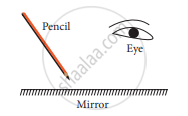
- Draw its image formed by the mirror
- Show how light rays from the object are reflected at the mirror to form the image for the eye.
What are the characteristics of an image formed in a plane mirror?
A virtual image is ______.
Match the following:
| 1. | Real image | a. | Diffuse reflection |
| 2. | Virtual image | b. | An optical device which produces reflection |
| 3. | Mirror | c. | Cannot be taken on screen |
| 4. | A type of light scattering | d. | Can be taken on screen |
Assertion (A): Virtual objects can’t be seen by the human eye.
Reason (R): Virtual image is formed by converging rays.
