Advertisements
Advertisements
प्रश्न
Mendel, in one of his experiments with pea plants, crossed a variety of pea plant having round seeds with one having wrinkled seeds. State Mendel’s observations giving reasons of F1 and F2 progeny of this cross. Also, list any two contrasting characters, other than round seeds of pea plants that Mendel used in his experiments.
Advertisements
उत्तर
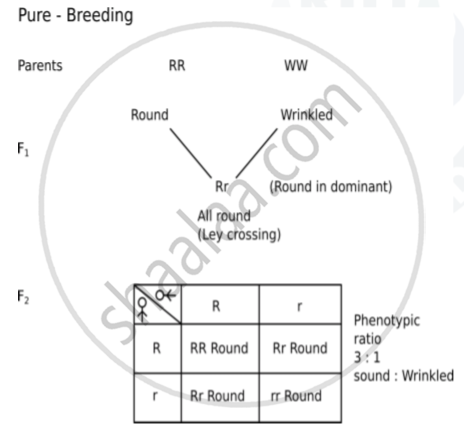
Other contracting characters :
| Height | Dominant | Recessive |
| Seed | Tall | .................... |
| color | Yellow | Green |
APPEARS IN
संबंधित प्रश्न
How did Mendel interpret his results to show that traits may be dominant or recessive? Describe briefly.
Using height (tallness/dwarfness) of a plant as an example, show that genes control the characteristics or traits in an organism.
In the F2 generation of a cross, progeny having different traits are produced in the ratio 3 : 1. State whether it is a monohybrid cross or a dihybrid cross? Give one example of such a cross.
What is the genotype of tall plants which always produced tall offspring
Which of the following statement is incorrect?
(a) for every hormone there is a gene
(b) for every protein there is a gene
(c) for production of every enzyme there is a gene
(d) for every type of fat there is a gene
Pure-bred pea plants A are crossed with pure-bred pea plants B. It is found that the plants which look like A do not appear in F1 generation but re-emerge in F2 generation. Which of the plants A and B are : (i) tall, and (ii) dwarf? Give reason for your answer.
"It is possible that a trait is inherited but may not be expressed." Give a suitable example to justify this statement.
Explain the mechanism of hereditary changes.
A cross between a tall plant (TT) and short pea plant (tt) resulted in progeny that were all tall plants because
A cross between pea plant with white flowers (vv) and pea plant with violet flowers (VV) resulted in F2 progeny in which ratio of violet (VV) and white (vv) flowers will be ______.
