Advertisements
Advertisements
प्रश्न
Maximize z = −x + 2y subjected to constraints x + y ≥ 5, x ≥ 3, x + 2y ≥ 6, y ≥ 0 is this LPP solvable? Justify your answer.
Advertisements
उत्तर
To draw the feasible region, construct table as follows:
| Inequality | x + y ≥ 5 | x ≥ 3 | x + 2y ≥ 6 |
| Corresponding equation (of line) | x + y = 5 | x = 3 | x + 2y = 6 |
| Intersection of line with X-axis | (5, 0) | (3, 0) | (6, 0) |
| Intersection of line with Y-axis | (0, 5) | − | (0, 3) |
| Region | Non-origin side | Non-origin side | Non-origin side |
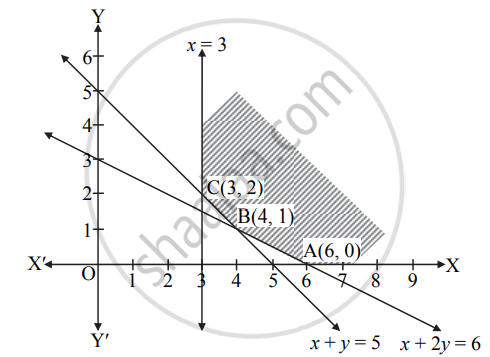
Shaded portion XABC is the feasible region, whose vertices are A (6, 0), B and C
B is the point of intersection of the lines x + y = 5 and x + 2y = 6
Solving the above equations, we get
B ≡ (4, 1)
C is the point of intersection of the lines x = 3 and x + y = 5
Putting x = 3 in x + y = 5, we get
3 + y = 5
∴ y = 2
∴ C ≡ (3, 2)
Here the objective function is
Z = −x + 2y
∴ Z at A(6, 0) = −6 + 2(0) = −6
Z at B(4, 1) = −4 + 2(1) = −2
Z at C(3, 2) = −3 + 2(2) = 1
Here, the feasible region is unbounded.
So, the objective function does not have finite maximum value i.e. value of objective function Z increases indefinitely and hence the L.P.P. has unbounded solution.