Advertisements
Advertisements
प्रश्न
Match the following
| Column A | Column B |
| (a). Human body | (1). electric bell |
| (b). Silk thread | (2). current |
| (c). Charge in motion | (3). conductor |
| (d). soft iron | (4). electromagnet |
| (e) . Electromagnet | (5). insulator |
Advertisements
उत्तर
| Column A | Column B |
| (a). Human body | (3). conductor |
| (b). Silk thread | (5). insulator |
| (c). Charge in motion | (2). current |
| (d). soft iron | (4). electromagnet |
| (e) . Electromagnet | (1). electric bell |
APPEARS IN
संबंधित प्रश्न
Write true or false of the following statement.
Magnetic keeper is a wooden piece.
Define the following term regarding a bar magnet:
Magnetic axis
If a bar magnet is cut into equal pieces by cutting it at right angles to its axis at two places, ______ bar magnets are formed, and a total of _____ poles are formed.
When magnetic material is taken close to a magnet, the material acquires ______.
Write the answer in your word.
Write the properties of a magnet.
Bar magnets are often stored in pairs as shown in the figure. E and F being pieces of metal.
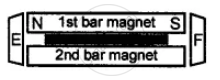
What is the material of darkened part?
Draw the magnetic field lines around a bar magnet when a bar magnet is placed such that the N pole points North.
Artificial magnets are made in different shapes such as ______, _____ and _______.
A magnet attracts ______.
The pole of a freely suspended magnet that points towards the north is called the south pole and what points towards the south is the celled north pole.
