Advertisements
Advertisements
प्रश्न
Marginal revenue should be equal to marginal cost, and marginal cost must cut MR from below. Constitute the conditions for the equilibrium of the firm. Discuss with examples.
Discuss producer's equilibrium in perfect competition, using MR and MC approach.
Advertisements
उत्तर
Another way to determine the firm's equilibrium is to look at its marginal revenue and cost. As is well known, marginal revenue is the net increase in total income that results from selling one more unit of production, whereas marginal cost is the increase in total cost that results from producing one more unit of output.
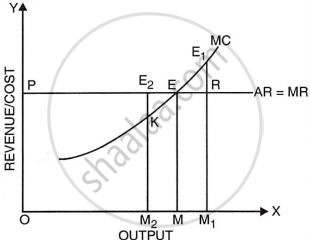
When a company is making the most money, it is said to be in equilibrium. Profits are maximized when marginal revenue and marginal cost are equal. The necessary but insufficient condition of equilibrium is equality between MR and MC. MC must cut MR from below in order to meet the second order criterion.
First order condition (i.e., MC = MR):
- This means the additional revenue from selling one more unit of the product is exactly equal to the additional cost of producing that unit.
- If MR > MC, the firm should increase its output, as it will add more to its profits.
- If MR < MC, the firm should reduce its output, as it will lose money on each additional unit produced.
- Only when MR = MC is the firm making the maximum possible profit.
- Example: Suppose a small garment manufacturer in India has the following cost and revenue structure. Producing the 100th shirt costs ₹200 (MC = ₹200). Selling the 100th shirt adds ₹200 to revenue (MR = ₹200). At this point, the firm is maximizing profit because any further production would add more to costs than to revenues.
Second-order condition (MC must cut MR from below):
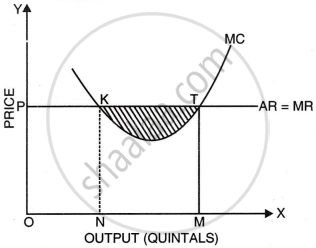
- This ensures that the profit is at a maximum and not a minimum.
- The MC curve must intersect the MR curve from below, indicating that costs are rising as output expands.
- If MC cuts MR from above, the firm would be at a loss point, not an equilibrium.
- Example: Imagine a bakery producing cakes in Mumbai. At a production level of 200 cakes, MR = ₹100 and MC = ₹100. If the cost to produce additional cakes (MC) continues to rise as output increases, this intersection is a stable equilibrium, maximizing profit. However, if MC were to fall after this point, it would indicate an unstable equilibrium, encouraging overproduction and potential losses.
Notes
Students should refer to the answer according to the question.
