Advertisements
Advertisements
प्रश्न
Advertisements
उत्तर
This is done to protect the appliances and circuits from any damage due to short-circuit and thus accidents like fire and fatal shocks. Earthing provides an easy and safe path to the excess current in the circuit and sends it to the ground.
APPEARS IN
संबंधित प्रश्न
One coulomb charge is equivalent to the charge contained in:
(a) 2.6 × 10¹⁹ electrons
(b) 6.2 × 10¹⁹ electrons
(c) 2.65 × 10¹⁸ electrons
(d) 6.25 × 10¹⁸ electrons
A flash of lighting carries 10 C of charge which flows for 0.01 s. What is the current? If the voltage is 10 MV, what is the energy?
The rating of a fuse connected in the lighting circuit is ______.
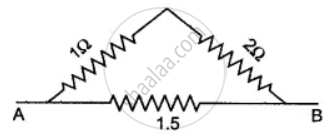
Calculate the effective resistance between the points A and B in the network shown below in Figure 8.45
An electric current flowing in a wire creates ______ around the wire.
An electric iron is rated 750 W, 230 V. Calculate the electrical energy consumed by the press in 16 hours.
In current electricity, a positive charge refers to ______.
Name any two devices, which are working on the heating effect of the electric current.
