Advertisements
Advertisements
प्रश्न
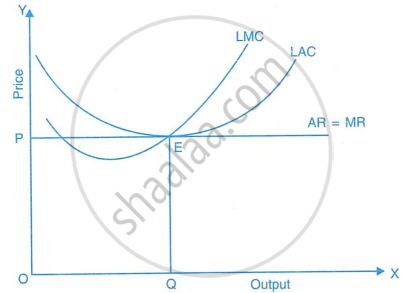
Long-run equilibrium of a firm under perfect competition occurs at a point where price equals the minimum long-run average cost. Explain it with the help of a diagram.
‘Long-run equilibrium for a firm in perfect competition occurs at a point where price equals minimum long-run average cost.’ Discuss in detail.
Advertisements
उत्तर
In the long run, a firm under perfect competition reaches equilibrium when:
Price = Average Revenue (AR) = Marginal Revenue (MR) = Marginal Cost (MC) = Minimum Long-Run Average Cost (LAC).
At this point:
- The firm operates at the minimum point of its LAC curve, known as the optimum output level.
- The MC curve intersects the MR curve from below.
- The AR curve is tangent to the LAC curve at its minimum point.
- The firm earns only normal profit, meaning it just covers its costs, including a normal return.
Since firms earn neither supernormal profits nor losses, there is no incentive for new firms to enter or existing firms to exit the industry.
This ensures market stability and maximum efficiency, which is why perfect competition is often used as a benchmark to evaluate other market structures.
Notes
Students should refer to the answer according to the question.
