Advertisements
Advertisements
प्रश्न
Long answer question.
Describe the models for enzyme actions.
थोडक्यात उत्तर
Advertisements
उत्तर
There are two types of models:
- Lock and Key model:
- The lock and Key model was first postulated in 1894 by Emil Fischer.
- This model explains the specific action of an enzyme with a single substrate.
- In this model, the lock is the enzyme and the key is the substrate.
- The correctly sized key (substrate) fits into the key hole (active site) of the lock (enzyme).

Lock and key model
- Induced Fit model (Flexible Model):
- Induced Fit model was first proposed in 1959 by Koshland.
- This model states that the approach of a substrate induces a conformational change in the enzyme.
- It is the more accepted model to understand the mode of action of an enzyme.
- The induced-fit model shows that enzymes are rather flexible structures in which the active site continually reshapes by its interactions with the substrate until the time the substrate is completely bound to it.
- It is also the point at which the final form and shape of the enzyme are determined.
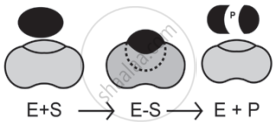
Complex Flexible model
shaalaa.com
Biomolecules in the Cell
या प्रश्नात किंवा उत्तरात काही त्रुटी आहे का?
APPEARS IN
संबंधित प्रश्न
Answer the following question.
Explain the induced fit model for the mode of enzyme action.
Match the following items given in column I and II.
| Column I | Column II | ||
| i. | RNA | a. | Induced fit model |
| ii. | Yam plant | b. | Flax seeds |
| iii. | Koshland | c. | Hydrolase |
| iv. | Omega-3-fatty acid | d. | Uracil |
| v. | Sucrase | e. | Anti-fertility pills |
Explain the biomolecules building blocks of life.
Long answer question.
Describe the types of lipids and mention their biological significance.
Long answer question.
What are enzymes?
Long answer question.
What are the types of RNA? Mention the role of each class of RNA.
Long answer question.
How metabolic pool is formed in the cell.
Long answer question.
What is metabolism?
Name the reagent used for testing for reducing sugar.
Identify the INCORRECT statement with respect to lipids.
