Advertisements
Advertisements
प्रश्न
Let the line L be the projection of the line: `(x - 1)/2 = ("y" - 3)/1 = ("z" - 4)/2` in the plane x – 2y – z = 3. If d is the distance of the point (0, 0, 6) from L, then d2 is equal to ______.
पर्याय
24
25
26
27
Advertisements
उत्तर
Let the line L be the projection of the line: `(x - 1)/2 = ("y" - 3)/1 = ("z" - 4)/2` in the plane x – 2y – z = 3. If d is the distance of the point (0, 0, 6) from L, then d2 is equal to 26.
Explanation:
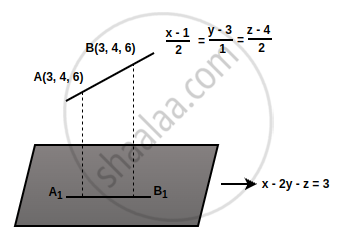
A1, B1 ⇒ foot of ⊥ A, B
`(α - 1)/1 = (β - 3)/(-2) = (ϒ - 4)/(-1) = (-(1 - 6 - 4 - 3))/6` = 2
⇒ A1 = (3, –1, 2)
`(α - 3)/1 = (β - 4)/(-2) = (ϒ - 6)/(-1) = (-(3 - 8 - 6 - 3))/6 = 7/3`
⇒ B1 = `(16/3, (-2)/3, 11/3)`
Drs of A1B1: `16/3 - 3, (-2)/3 + 1, 11/3 - 2`
⇒ `7/3, 1/3, 5/3`
∴ L: `(x - 3)/(7/3) = ("y" + 1)/(1/3) = ("z" - 2)/(5/3)` = ℓ
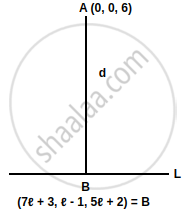
`(7/3ℓ + 3, ℓ/3 - 1, 5/3ℓ + 2)` = B
Drs of AB: `7/3ℓ + 3, ℓ/3 - 1, 5/3ℓ - 4`
`bar("AB") ⊥ "L"` ⇒ `7/3(7/3ℓ + 3) + 1/3(ℓ/3 - 1) + 5/3(5/3ℓ - 4)` = 0
`(49/9 + 1/9 + 25/9)l + 21/3 - 1/3 - 20/3` = 0
`75/9ℓ` = 0 ⇒ ℓ = 0. So the point B = (3, –1, 2)
∴ Distance, AB = d
= `sqrt((3 - 0)^2 + (-1 - 0)^2 + (2 - 6)^2)`
`sqrt(9 + 1 + 16) = sqrt(26)`
⇒ d2 = 26
