Advertisements
Advertisements
प्रश्न
Let f: R → R be a function defined by:
f(x) = `{{:(max_(t ≤ x){t^3 - 3t},;, x ≤ 2),(x^2 + 2x - 6,;, 2 < x ≤ 3),([x - 3] + 9,;, 3 < x ≤ 5),(2x + 1,;, x > 5):}`
where [t] is the greatest integer less than or equal to t. Let m be the number of points where f is not differentiable and I = `int_-2^2f(x)dx`. Then the ordered pair (m, I) is equal to ______.
पर्याय
`(3, 27/4)`
`(3, 23/4)`
`(4, 27/4)`
`(4, 23/4)`
Advertisements
उत्तर
Let f: R → R be a function defined by:
f(x) = `{{:(max_(t ≤ x){t^3 - 3t},;, x ≤ 2),(x^2 + 2x - 6,;, 2 < x ≤ 3),([x - 3] + 9,;, 3 < x ≤ 5),(2x + 1,;, x > 5):}`
where [t] is the greatest integer less than or equal to t. Let m be the number of points where f is not differentiable and I = `int_-2^2f(x)dx`. Then the ordered pair (m, I) is equal to `underlinebb((4, 27/4)`.
Explanation:
Given: f: R → R
f(x) = `{{:(max_(t ≤ x){t^3 - 3t}, x ≤ 2),(x^2 + 2x - 6, 2 < x ≤ 3),([x - 3] + 9, 3 < x ≤ 5),(2x + 1, x > 5):}`
The graph of y = t3 – 3t is:
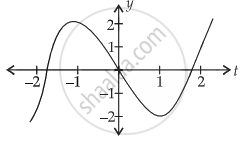
For `x ≤ -1, max_(t < x) {t^3 - 3t} = x^3 - 3x`
For `-1 < x ≤ 2, max_(t < x) {t^3 - 3t} = 2`
∴ f(x) = `{{:(x^3 - 3x, x ≤ -1),(2, -1 < x ≤ 2),(x^2 + 2x - 6, 2 < x ≤ 3),(9, 3 < x ≤ 4),(10, 4 < x < 5),(11, x = 5),(2x + 1, x > 5):}`

As we know, a function is not differentiable at sharp points and at points of discontinuity
⇒ f(x) is not differentiable at x = 2, 3, 4, 5
∴ The number of points where f(x) is not differentiable = 4
⇒ m = 4
Now, I = `int_(-2)^2f(x)dx`
⇒ I = `int_(-2)^(-1) f(x)dx + int_(-1)^2 f(x)dx`
⇒ I = `int_(-2)^(-1) (x^3 - 3x)dx + int_(-1)^2 2dx`
⇒ I = `[x^4/4 - (3x^2)/2]_(-2)^(-1) + [2x]_(-1)^2`
⇒ I = `(1/4 - 3/2 - 16/4 + 6) + (4 - (-2))`
⇒ I = `(1/4 - 3/2 + 2) + 6`
⇒ I = `(1 - 6 + 32)/4`
⇒ I = `27/4`
∴ The ordered pair (m, I) = `(4, 27/4)`
