Advertisements
Advertisements
प्रश्न
Let ABCD be a square of side of unit length. Let a circle C1 centered at A with unit radius is drawn. Another circle C2 which touches C1 and the lines AD and AB are tangent to it, is also drawn. Let a tangent line from the point C to the circle C2 meet the side AB at E. If the length of EB is `α + sqrt(3)β`, where α, β are integers, then α + β is equal to ______.
पर्याय
0
1
2
3
Advertisements
उत्तर
Let ABCD be a square of side of unit length. Let a circle C1 centered at A with unit radius is drawn. Another circle C2 which touches C1 and the lines AD and AB are tangent to it, is also drawn. Let a tangent line from the point C to the circle C2 meet the side AB at E. If the length of EB is `α + sqrt(3)β`, where α, β are integers, then α + β is equal to 1.
Explanation:
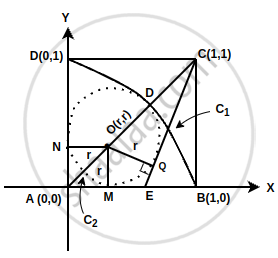
C1: Center = A(0, 0)
Radius = 1 unit = AD
OD = AM = MO = r
⇒ AO = `sqrt(2)r`
∵ AD = 1
AO + OD = 1
⇒ `sqrt(2) + r` = 1
⇒ r = `1/(sqrt(2) + 1)`
⇒ r = `sqrt(2) - 1`
So for circle C2: Center is (r, r) and Radius is `sqrt(2) - 1`.
So, equation circle will be `(x - r)^2 + (y - r)^2 = (sqrt(2) - 1)^2`
Let slope of line, which passes through point C(1, 1) and Eis m. Then equation of line will be y – 1 = m(x – 1);
m > 0 (From figure)
mx – y + 1 – m = 0 ...(i)
Line CE will be tangent to circle C2 if OQ = r; where OQ is perpendicular distance of point O(r, r) from the line CE.
Hence, `|(mr - r + 1 - m)/sqrt(m^2 + 1)| = sqrt(2) - 1; r = sqrt(2) - 1`
⇒ `|((r - 1)(m - 1))/sqrt(m^2 + 1)| = sqrt(2) - 1`
As r = `sqrt(2) - 1`
⇒ `|((sqrt(2) - 2)(m - 1))/sqrt(m^2 + 1)| = sqrt(2) - 1`
⇒ `|(sqrt(2)(m - 1))/sqrt(m^2 + 1)|` = 1
Squaring both the sides
⇒ `(2(m - 1)^2)/(m^2 + 1)` = 1
⇒ m2 – 4m + 1 = 0
⇒ m = `2 +- sqrt(3)`
As m > 0, `2 - sqrt(3)` rejected
m = `2 + sqrt(3)`
Now using equation (i)
`(2 + sqrt(3))x - y + 1 - (2 + sqrt(3))` = 0
For E, y = 0
x = `(sqrt(3) + 1)/(2 + sqrt(3))`
⇒ x = `sqrt(3) - 1`
`E(sqrt(3) - 1, 0)` and B(1, 0)
EB = OB – OE
EB = `1 - (sqrt(3) - 1)`
EB = `2 - sqrt(3)`
`α + sqrt(3)β = 2 + sqrt(3)(-1)`; EB = ` α + sqrt(3)β`
After comparing we get
α = 2, β = –1
α + β = 1.
