Advertisements
Advertisements
प्रश्न
Let `bara` and `barb` be non-collinear vectors. If vector `barr` is coplanar with `bara` and `barb`, then prove that there exist unique scalars t1 and t2 such that `barr = t_1 bara + t_2 barb`. Hence find t1 and t2 for `barr = hati + hatj, bara = 2hati - hatj, barb = hati - 2hatj`.
Advertisements
उत्तर
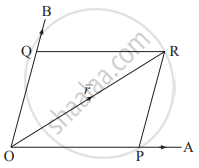
Let `bara, barb, barr` be coplanar.
Take any point O in the plane of `bara, barb` and `barr`. Represents the vectors `bara, barb` and `barr` by `bar(OA), bar(OB)` and `bar(OR)`.
Take the point P on `bara` and Q on `barb` such that OPRQ is a parallelogram.
Now, `bar(OP)` and `bar(OA)` are collinear vectors.
∴ There exists a non-zero scalar t1 such that
`bar(OP) = t_1 · bar(OA) = t_1 · bara`
Also, `bar(OQ)` and `bar(OB)` are collinear vectors.
∴ There exists a non-zero scalar t2 such that
`bar(OQ) = t_2 · bar(OB) = t_2 · barb`
Now, by parallelogram law of addition of vectors,
`bar(OR) = bar(OP) + bar(OQ)`
∴ `barr = t_1bara + t_2barb`
Thus, `barr` is expressed as a linear combination `t_1 bara + t_2 barb`
Uniqueness:
Let, if possible, `barr = t_1^'bara + t_2^'barb`, where `t_1^'` and `t_2^'` are non-zero scalars. Then,
`t_1bara + t_2barb = t_1^'bara + t_2^'barb`
∴ `(t_1 - t_1^')bara = -(t_2 - t_2^')barb` ....(1)
We want to show that `t_1= t_1^'` and `t_2 = t_2^'`.
Suppose `t_1 ≠ t_1^'`, i.e., `t_1 - t_1^' ≠ 0` and `t_2 ≠ t_2^'`, i.e., `t_2 - t_2^' ≠ 0`.
Then dividing both sides of (1) by `t_1 - t_1^'`, we get
`bara = -((t_2 - t_2^')/(t_1 - t_1^'))barb`
This shows that the vector `bara` is a non-zero scalar multiple of `barb`.
∴ `bara` and `barb` are collinear vectors.
This is a contradiction since `bara` and `barb` are given to be non-collinear.
∴ `t_1 = t_1^'`
Similarly, we can show that `t_2 = t_2^'`.
This shows that `barr` is uniquely expressed as a linear combination of `t_1bara + t_2 barb`.
If `barr = hati + hatj, bara = 2hati - hatj` and `barb = hati - 2hatj`, then `barr = hati + hatj = 1(2hati - hatj) + (-1)(hati - 2hatj)`
∴ `barr = 1⋅bara + (-1)barb`
This is of the form `barr = t_1bara + t_2barb`, where t1 = 1 and t2 = −1.
