Advertisements
Advertisements
प्रश्न
Let A = {a, b, c} and R = {(a, a), (b, b), (a, c)}. Write down the minimum number of ordered pairs to be included to R to make it equivalence
Advertisements
उत्तर
Given A = {a, b, c}
R = {(a, a), (b, b), (a, c)}
After including the ordered pairs (c, c), (c, a) to R the new relation becomes
R1 = {(a, a), (b, b), (c, c), (a, c), (c, a)}
R1 is reflexive symmetric and transitive.
∴ R1 is an equivalence relation.
APPEARS IN
संबंधित प्रश्न
The given figure shows a relationship between the sets P and Q. Write this relation
- in set-builder form.
- in roster form.
What is its domain and range?
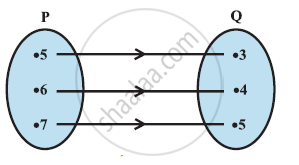
Define a relation R on the set N of natural number by R = {(x, y) : y = x + 5, x is a natural number less than 4, x, y ∈ N}. Depict this relationship using (i) roster form (ii) an arrow diagram. Write down the domain and range or R.
The adjacent figure shows a relationship between the sets P and Q. Write this relation in (i) set builder form (ii) roster form. What is its domain and range?
If R = [(x, y) : x, y ∈ W, 2x + y = 8], then write the domain and range of R.
If A = [1, 2, 3], B = [1, 4, 6, 9] and R is a relation from A to B defined by 'x' is greater than y. The range of R is
Select the correct answer from given alternative.
The relation ">" in the set of N (Natural number) is
Answer the following:
R = {1, 2, 3} → {1, 2, 3} given by R = {(1, 1), (2, 2), (3, 3), (1, 2), (2, 3)} Check if R is reflexive
Answer the following:
Show that the relation R in the set A = {1, 2, 3, 4, 5} Given by R = {(a, b)/|a − b| is even} is an equivalence relation.
Answer the following:
Show that the following is an equivalence relation
R in A is set of all books. given by R = {(x, y)/x and y have same number of pages}
Represent the given relation by
(a) an arrow diagram
(b) a graph and
(c) a set in roster form, wherever possible
{(x, y) | y = x + 3, x, y are natural numbers < 10}
Multiple Choice Question :
The range of the relation R = {(x, x2) | x is a prime number less than 13} is ________
Discuss the following relation for reflexivity, symmetricity and transitivity:
The relation R defined on the set of all positive integers by “mRn if m divides n”
Discuss the following relation for reflexivity, symmetricity and transitivity:
Let A be the set consisting of all the female members of a family. The relation R defined by “aRb if a is not a sister of b”
Let A = {a, b, c} and R = {(a, a), (b, b), (a, c)}. Write down the minimum number of ordered pairs to be included to R to make it transitive
On the set of natural numbers let R be the relation defined by aRb if a + b ≤ 6. Write down the relation by listing all the pairs. Check whether it is transitive
Choose the correct alternative:
The relation R defined on a set A = {0, −1, 1, 2} by xRy if |x2 + y2| ≤ 2, then which one of the following is true?
Is the given relation a function? Give reasons for your answer.
h = {(4, 6), (3, 9), (– 11, 6), (3, 11)}
Let S = {x ∈ R : x ≥ 0 and `2|sqrt(x) - 3| + sqrt(x)(sqrt(x) - 6) + 6 = 0}`. Then S ______.
A function from set \(A\) to set \(B\) is a relation in which:
Let \(A=\{1,2,3,4,5\}\), \(B=\{1,4,5\}\), and \((x,y)\in R\) imply \(x
