मराठी
महाराष्ट्र राज्य शिक्षण मंडळएचएससी विज्ञान (सामान्य) इयत्ता १२ वी

Let A(a¯) and B(b¯) be any two points in the space and R(r¯) be a point on the line segment AB dividing it internally in the ratio m : n, then prove that r¯=mb¯+na¯m+n. - Mathematics and Statistics

Advertisements
Advertisements

प्रश्न

Let `A(bara)` and `B(barb)` be any two points in the space and `R(barr)` be a point on the line segment AB dividing it internally in the ratio m : n, then prove that `bar r=(mbarb+nbara)/(m+n)`. Hence find the position vector of R which divides the line segment joining the points A(1, –2, 1) and B(1, 4, –2) internally in the ratio 2 : 1.

बेरीज
Advertisements

उत्तर

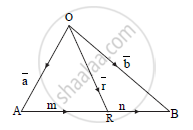
Consider a line segment AB. 

Let R be any point on it such that point R divides AB internally in the ratio m : n.
bar(OA) = bara, bar(OR) = barr and bar(OB) = barb are the position vectors of points A, R, B respectively. Since point R divides AB internally in the ratio m : n,

`(AR)/(RB)=m/n`

`n(AR)=m(RB)`

`bar(AR) and bar(RB)` are in the same direction.

`therefore n(bar(AR))=m(bar(RB))`

`n(barr-bara)=m(barb-barr)`

`nbarr-nbara=mbarb-mbarr`

`nbarr+mbarr=mbarb+nbara`

`barr(m+n)=mbarb+nbara`

`barr=(mbarb+nbara)/(m+n)`    ...(1)

This is the section formula for internal division

Let P.V. of point `A bara=hati-2hatj+hatk`

P. V. of point `B barb=hati+4hatj-2hatk`

Given, `m/n=2/1`

Now, `bar r=(2(hati+4hatj-2hatk)+1(hati-2hatj+hatk))/(2+1)`  ...From (1)

`bar r=(3hati+6hatj-3hatk)/3`

P. V. of R is `bar r=hati+2hatj-hatk`

shaalaa.com
  या प्रश्नात किंवा उत्तरात काही त्रुटी आहे का?
2016-2017 (July)

APPEARS IN

व्हिडिओ ट्यूटोरियलVIEW ALL [2]

संबंधित प्रश्‍न

The Cartesian equations of line are 3x -1 = 6y + 2 = 1 - z. Find the vector equation of line.


The Cartestation equation of  line is `(x-6)/2=(y+4)/7=(z-5)/3` find its vector equation.


Find the value of p, so that the lines `l_1:(1-x)/3=(7y-14)/p=(z-3)/2 and l_2=(7-7x)/3p=(y-5)/1=(6-z)/5 ` are perpendicular to each other. Also find the equations of a line passing through a point (3, 2, – 4) and parallel to line l1.


Show that the line through the points (1, −1, 2) (3, 4, −2) is perpendicular to the line through the points (0, 3, 2) and (3, 5, 6).


Show that the line through the points (4, 7, 8) (2, 3, 4) is parallel to the line through the points (−1, −2, 1), (1, 2, 5).


The Cartesian equation of a line is `(x-5)/3 = (y+4)/7 = (z-6)/2` Write its vector form.


Find the vector and the Cartesian equations of the lines that pass through the origin and (5, −2, 3).


Show that the lines `(x-5)/7 = (y + 2)/(-5) = z/1` and `x/1 = y/2 = z/3` are perpendicular to each other.


Show that the line joining the origin to the point (2, 1, 1) is perpendicular to the line determined by the points (3, 5, – 1), (4, 3, – 1).


ABCD is a parallelogram. The position vectors of the points AB and C are respectively, \[4 \hat{ i} + 5 \hat{j} -10 \hat{k} , 2 \hat{i} - 3 \hat{j} + 4 \hat{k}  \text{ and } - \hat{i} + 2 \hat{j} + \hat{k} .\]  Find the vector equation of the line BD. Also, reduce it to cartesian form.


Find in vector form as well as in cartesian form, the equation of the line passing through the points A (1, 2, −1) and B (2, 1, 1).


Find the vector equation of a line passing through the point with position vector  \[\hat{i} - 2 \hat{j} - 3 \hat{k}\]  and parallel to the line joining the points with position vectors  \[\hat{i} - \hat{j} + 4 \hat{k} \text{ and } 2 \hat{i} + \hat{j} + 2 \hat{k} .\] Also, find the cartesian equivalent of this equation.


Find the cartesian and vector equations of a line which passes through the point (1, 2, 3) and is parallel to the line  \[\frac{- x - 2}{1} = \frac{y + 3}{7} = \frac{2z - 6}{3} .\] 


Show that the line through the points (1, −1, 2) and (3, 4, −2) is perpendicular to the through the points (0, 3, 2) and (3, 5, 6).


Find the cartesian equation of the line which passes through the point (−2, 4, −5) and parallel to the line given by  \[\frac{x + 3}{3} = \frac{y - 4}{5} = \frac{z + 8}{6} .\]


Find the angle between the following pair of line:

\[\frac{x - 2}{3} = \frac{y + 3}{- 2}, z = 5 \text{ and } \frac{x + 1}{1} = \frac{2y - 3}{3} = \frac{z - 5}{2}\]


Find the foot of the perpendicular drawn from the point A (1, 0, 3) to the joint of the points B (4, 7, 1) and C (3, 5, 3). 


Find the foot of the perpendicular drawn from the point  \[\hat{i} + 6 \hat{j} + 3 \hat{k} \]  to the line  \[\overrightarrow{r} = \hat{j} + 2 \hat{k} + \lambda\left( \hat{i} + 2 \hat{j} + 3 \hat{k}  \right) .\]  Also, find the length of the perpendicular


Find the foot of the perpendicular from (1, 2, −3) to the line \[\frac{x + 1}{2} = \frac{y - 3}{- 2} = \frac{z}{- 1} .\]


Find the equation of line passing through the points A (0, 6, −9) and B (−3, −6, 3). If D is the foot of perpendicular drawn from a point C (7, 4, −1) on the line AB, then find the coordinates of the point D and the equation of line CD


Find the shortest distance between the following pairs of lines whose cartesian equations are: \[\frac{x - 1}{2} = \frac{y - 2}{3} = \frac{z - 3}{4} and \frac{x - 2}{3} = \frac{y - 3}{4} = \frac{z - 5}{5}\] 


Find the shortest distance between the following pairs of lines whose cartesian equations are : \[\frac{x - 1}{2} = \frac{y + 1}{3} = z \text{ and } \frac{x + 1}{3} = \frac{y - 2}{1}; z = 2\]


Find the shortest distance between the following pairs of lines whose cartesian equations are : \[\frac{x - 1}{- 1} = \frac{y + 2}{1} = \frac{z - 3}{- 2} \text{ and } \frac{x - 1}{1} = \frac{y + 1}{2} = \frac{z + 1}{- 2}\]


Find the equations of the lines joining the following pairs of vertices and then find the shortest distance between the lines

 (1, 3, 0) and (0, 3, 0)


Write the cartesian and vector equations of Z-axis.


Write the vector equation of a line passing through a point having position vector  \[\overrightarrow{\alpha}\] and parallel to vector \[\overrightarrow{\beta}\] .


Write the direction cosines of the line \[\frac{x - 2}{2} = \frac{2y - 5}{- 3}, z = 2 .\]


Write the coordinate axis to which the line \[\frac{x - 2}{3} = \frac{y + 1}{4} = \frac{z - 1}{0}\]  is  perpendicular.


Write the value of λ for which the lines  \[\frac{x - 3}{- 3} = \frac{y + 2}{2\lambda} = \frac{z + 4}{2} \text{ and } \frac{x + 1}{3\lambda} = \frac{y - 2}{1} = \frac{z + 6}{- 5}\]  are perpendicular to each other.


The equations of a line are given by \[\frac{4 - x}{3} = \frac{y + 3}{3} = \frac{z + 2}{6} .\]  Write the direction cosines of a line parallel to this line.


The direction ratios of the line perpendicular to the lines \[\frac{x - 7}{2} = \frac{y + 17}{- 3} = \frac{z - 6}{1} \text{ and }, \frac{x + 5}{1} = \frac{y + 3}{2} = \frac{z - 4}{- 2}\] are proportional to


If a line makes angles α, β and γ with the axes respectively, then cos 2 α + cos 2 β + cos 2 γ =


If the direction ratios of a line are proportional to 1, −3, 2, then its direction cosines are


The straight line \[\frac{x - 3}{3} = \frac{y - 2}{1} = \frac{z - 1}{0}\] is


Show that the lines \[\frac{5 - x}{- 4} = \frac{y - 7}{4} = \frac{z + 3}{- 5} \text { and } \frac{x - 8}{7} = \frac{2y - 8}{2} = \frac{z - 5}{3}\] are coplanar.


Find the position vector of a point A in space such that `vec"OA"` is inclined at 60º to OX and at 45° to OY and `|vec"OA"|` = 10 units.


Find the vector equation of a line passing through a point with position vector `2hati - hatj + hatk` and parallel to the line joining the points `-hati + 4hatj + hatk` and `-hati + 2hatj + 2hatk`.


Equation of a line passing through (1, 1, 1) and parallel to z-axis is ______.


Share
Notifications

Englishहिंदीमराठी


      Forgot password?
Use app×