Advertisements
Advertisements
प्रश्न
Label the diagram and write down the detail of the concept in your word.

Advertisements
उत्तर
Chloroplast plays a significant role in the synthesis of starch in plants.
Structure of chloroplast:
- In plants, the chloroplast is found mainly in mesophyll of leaf.
- A chloroplast is lens-shaped but it can also be oval, spherical, discoid, or ribbon-like.
- A cell may contain a single large chloroplast as in Chlamydomonas or there can be 20 to 40 chloroplasts per cell as seen in mesophyll cells.
- Chloroplasts contain a green pigment called chlorophyll along with other enzymes that help in the production of sugar by photosynthesis.
- Inner membrane of double membraned chloroplast is comparatively less permeable.
- Inside the cavity of inner membrane, there is another set of membranous sacs called thylakoids.
- Thylakoids are arranged in the form of stacks called grana (singular: granum).
- The grana are connected to each other by means of membranous tubules called stroma lamellae.
- Space outside thylakoids is filled with stroma.
- The stroma and space inside thylakoids contain various enzymes essential for photosynthesis.
- Stroma of chloroplast contains DNA and ribosomes (70S).
APPEARS IN
संबंधित प्रश्न
Choose the correct option.
Cell Wall is present in
Choose the correct option.
Plasma membrane is ______.
Choose the correct option.
Golgi body is absent in
Answer the following question.
Is nucleolus covered by membrane?
Answer the following question.
The RBC surface normally shows glycoprotein molecules. When determining blood group do they play any role?
Label the diagram and write down the detail of the concept in your word.

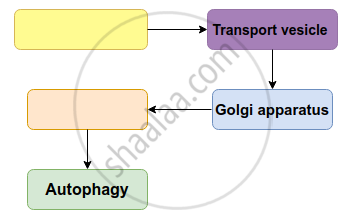
Complete the flow chart.
Identify cell structure or organelle from it's the description below.
Manufactures ATP in animal and plant cells.
Identify cell structure or organelle from its description below.
Selectivelly permeable.
Which of the following is not present in mitochondrial matrix?
