Advertisements
Advertisements
प्रश्न
It is a well known fact that during a total solar eclipse the disk of the moon almost completely covers the disk of the Sun. From this fact and from the information you can gather from examples 2.3 and 2.4, determine the approximate diameter of the moon.
Advertisements
उत्तर १
The position of the Sun, Moon, and Earth during a lunar eclipse is shown in the given figure.
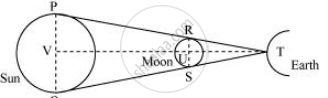
Distance of the Moon from the Earth = 3.84 × 10⁸ m
Distance of the Sun from the Earth = 1.496 × 10¹¹ m
Diameter of the Sun = 1.39 × 10⁹ m
It can be observed that ΔTRS and ΔTPQ are similar. Hence, it can be written as:
`(PQ)/(RS) = (VT)/(UT)`
`(1.39xx10^9)/(RS) = (1.496xx 10^11)/(3.84xx10^(8))`
`RS = (1.39xx3.84)/1.496 xx 10^6 = 3.57 xx10 ^6 m`
Hence, the diameter of the Moon is 3.57× 10⁶ m.
उत्तर २
From examples we get θ = 1920″ and S = 3.8452 x 10⁸ m.
During the total solar eclipse, the disc of the moon completely covers the disc of the sun, so the angular diameter of both the sun and the moon must be equal. Angular diameter of the moon, θ= Angular diameter of the sun
= 1920″ = 1920 x 4.85 x 10-6 rad [1″ = 4.85 x 10⁻⁶ rad]
The earth-moon distance, S = 3.8452 x 10⁸ m .’. The diameter of the moon, D = θ x S
= 1920 x 4.85 x 10-6 x 3.8452 x 108 m = 35806.5024 x 102 m
= 3581 x 103 m 3581 km.
संबंधित प्रश्न
Round up the following upto three significant figures:
34.216
Round up the following upto three significant figures:
0.04597
The length, breadth, and thickness of a rectangular sheet of metal are 4.234 m, 1.005 m, and 2.01 cm respectively. Give the area and volume of the sheet to correct significant figures.
The mass of a box measured by a grocer’s balance is 2.300 kg. Two gold pieces of masses 20.15 g and 20.17 g are added to the box. What is
- What is the total mass of the box?
- What is the difference in the masses of the pieces to correct significant figures?
Precise measurements of physical quantities are a need of science. For example, to ascertain the speed of an aircraft, one must have an accurate method to find its positions at closely separated instants of time. This was the actual motivation behind the discovery of radar in World War II. Think of different examples in modern science where precise measurements of length, time, mass etc. are needed. Also, wherever you can, give a quantitative idea of the precision needed.
A man walking briskly in rain with speed v must slant his umbrella forward making an angle θ with the vertical. A student derives the following relation between θ and v: tan θ = v and checks that the relation has a correct limit: as v →0, θ → 0, as expected. (We are assuming there is no strong wind and that the rain falls vertically for a stationary man). Do you think this relation can be correct? If not, guess the correct relation.
State the number of significant figures in the following:
6.320 J
State the number of significant figures in the following:
0.0006032 m2
Describe what is meant by significant figures.
A large ball 2 m in radius is made up of a rope of square cross-section with edge length 4 mm. Neglecting the air gaps in the ball, what is the total length of the rope to the nearest order of magnitude?
How many significant figures should be present in the answer of the following calculations?
`(2.5 xx 1.25 xx 3.5)/2.01`
Taking into account of the significant figures, what is the value of 9.99 m – 0.0099 m?
If the density of a solution is 3.12 g mL–1, the mass of 1.5 mL solution in significant figures is ______.
The sum of the numbers 436.32, 227.2 and 0.301 in appropriate significant figures is ______.
The mass and volume of a body are 4.237 g and 2.5 cm3, respectively. The density of the material of the body in correct significant figures is ______.
The numbers 2.745 and 2.735 on rounding off to 3 significant figures will give ______.
Significant figures in a measurement include which of the following?
The radius of Earth is written as 0.64 × 10⁷ m in scientific notation. What is its order of magnitude?
What is the least count of a measuring instrument?
