In the Venn diagram 𝜉 = {people at a function} A = {those who asked for tea} B = {those who watched the ballet} Write down the number who: (i) asked for tea (ii) asked for tea and watched the ballet
Advertisements
प्रश्न
In the Venn diagram
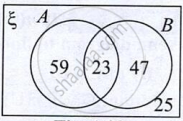
\[\xi\] = {people at a function}
A = {those who asked for tea}
B = {those who watched the ballet}
Write down the number who:
(i) asked for tea
(ii) asked for tea and watched the ballet
(iii) neither asked for tea nor watched the ballet
(iv) attended the function
Advertisements
उत्तर
From the Venn diagram:
People who asked only for tea: n(A − B) = 59
People who asked for tea and watched the ballet: n(A ∩ B) = 23
People who only watched the ballet: n(B − A) = 47
People who neither asked for tea nor watched the ballet: n(A ∪ B)' = 25
(i) Number who asked for tea:
n(A) = 59 + 23 = 82
(ii) Number who asked for tea and watched the ballet:
n(A ∩ B) = 23
(iii) Number who neither asked for tea nor watched the ballet:
n(A ∪ B)' = 25
(iv) Number who attended the function:
\[\text{n}(\xi)\] = 59 + 23 + 47 + 25 = 154
