Advertisements
Advertisements
प्रश्न
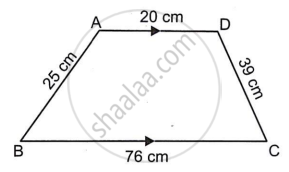
In the trapezium ABCD, AD || BC, AB = 25 cm, BC = 76 cm, CD = 39 cm, AD = 20 cm, find its area.
Advertisements
उत्तर
We are given a trapezium ABCD with:
- AD || BC → AD and BC are the parallel sides
- AB = 25 cm
- BC = 76 cm
- CD = 39 cm
- AD = 20 cm
We need to find the area of the trapezium.
Step-by-step:
Use the area formula for a trapezium:
Area = `1/2`× sum of parallel × height
We know:
Parallel sides: AD = 20 cm, BC = 76 cm
We must now find the height of the trapezium.
Step 1: Use Pythagoras theorem in triangle ΔABX and ΔCDY
Let perpendiculars from A and D fall on BC at points X and Y, forming height h.
So, total base BC = BX + XY + YC = 76
Let:
- BX = x
- YC = y
- So, x + y + 20 = 76
⇒ x + y = 56
Use right triangles:
1. In ΔABX:
AB2 = h2 + x2
⇒ 252 = h2 + x2 ...(1)
2. In ΔCDY:
CD2 = h2 + y2
⇒ 392 = h2 + y2 ...(2)
Now subtract (1) from (2):
392 – 252 = y2 – x2
= (y + x)(y – x)
⇒ (y + x)(y – x) = 1521 – 625
⇒ (y + x)(y – x) = 896
⇒ 56(y – x) = 896
⇒ `y - x = 896/56`
⇒ y – x = 16
Now solve:
- x + y = 56
- y – x = 16
Add both:
2y = 72
⇒ y = 36, x = 20
Now plug into (1):
252 = h2 + 202
⇒ 625 = h2 + 400
⇒ h2 = 225
⇒ h = 15 cm
Step 2: Area calculation
Area = `1/2` × (AD + BC) × h
= `1/2 xx (20 + 76) xx 15`
= `(96 xx 15)/2`
= 720 cm2
