Advertisements
Advertisements
प्रश्न
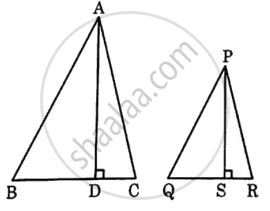
In the given figure, two triangles ABC and PQR are shown such that ∠A = ∠P and ∠C = ∠R. If AD ⊥ BC and PS ⊥ QR, then prove that (i) ΔADB ~ ΔPSQ (ii) AD × QS = BD × PS.
Advertisements
उत्तर
Given:
Two triangles ABC and PQR such that ∠A = ∠P and ∠C = ∠R.
AD ⊥ BC and PS ⊥ QR
To Prove:
- ΔADB ~ ΔPSQ
- AD × QS = BD × PS
(i) Prove ΔADB ~ ΔPSQ
Step 1: Identify the right angles
Since AD ⊥ BC, ∠ADB = 90°.
Since PS ⊥ QR, ∠PSQ = 90°.
Step 2: Given angles
∠A = ∠P ...(Given)
Step 3: Use Angle-Angle (AA) similarity criterion
In ΔADB and ΔPSQ, we have:
∠ADB = ∠PSQ = 90°
∠A = ∠P ...(Given)
Therefore, by AA similarity criterion,
ΔADB ~ ΔPSQ
(ii) Prove AD × QS = BD × PS
Since ΔADB ∼ ΔPSQ, corresponding sides are proportional:
`(AD)/(PS) = (BD)/(QS) = (AB)/(PQ)`
From the first two ratios:
`(AD)/(PS) = (BD)/(QS)`
⇒ AD × QS = BD × PS
This proves the required relation.
Hence, both parts (i) and (ii) are proved.
