Advertisements
Advertisements
प्रश्न
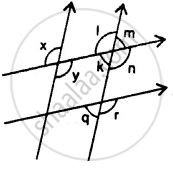
In the given figure, the arrows indicate parallel lines. State which angles are equal. Give a reason.
Advertisements
उत्तर
In the figure,
x = y ......(vertically opposite angles)
y= l .........(alternate angles)
x = I .......(corresponding angles)
1 = n .......(vertically opposite angles)
n = r .......(corresponding angles)
∴ x = y = l = n = r
Again m = k ......(vertically opposite angles)
k = q ........(corresponding angles)
∴ m = k = q
APPEARS IN
संबंधित प्रश्न
Fill in the blank so as to make the following statement true:
A ray stands on a line, then the sum of the two adjacent angles so formed is ______
State, true or false:
A ray has one endpoint and a line segment has two end-points.
How many lines can be drawn through three
(a) collinear points?
(b) non-collinear points?
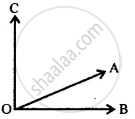
In the following figure, ∠AOB and ∠AOC are adjacent angles? Give the reason for your answer.
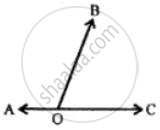
In the following figure, ∠AOB and ∠AOC are adjacent angles? Give the reason for your answer.
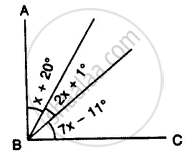
In the given figure, AB is perpendicular to BC at B.
Find:
(i) the value of x.
(ii) the complement of angle x.
Write the complement of (30 − a)°
Write the supplement of (90 + a + b)°
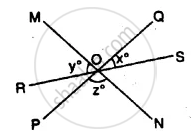
In the given figure, lines PQ, MN, and RS intersect at O. If x : y = 1 : 2 and z = 90°, find ∠ROM and ∠POR.
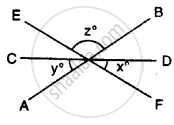
AB, CD and EF are three lines intersecting at the same point.
(i) Find x, if y = 45° and z = 90°.
(ii) Find a, if x = 3a, y = 5x and r = 6x.