Advertisements
Advertisements
प्रश्न
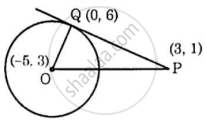
In the given figure, PQ is a tangent to a circle with centre O(–5, 3). If coordinates of P and Q are (3, 1) and (0, 6) respectively, then using distance formula, show that PQ ⊥ OQ.
Advertisements
उत्तर
Given:
Centre O = (–5, 3), P = (3, 1), Q = (0, 6).
PQ is a tangent at Q, so the radius OQ is perpendicular to the tangent at Q.
Step-wise calculation:
1. Use the distance formula d2 = (x2 – x1)2 + (y2 – y1)2.
2. Compute OQ2: O = (–5, 3), Q = (0, 6)
OQ2 = (0 – (–5))2 + (6 – 3)2
= 52 + 32
= 25 + 9
= 34
3. Compute PQ2: P = (3, 1), Q = (0, 6)
PQ2 = (3 – 0)2 + (1 – 6)2
= 32 + (–5)2
= 9 + 25
= 34
4. Compute OP2 to apply the converse of Pythagoras:
O = (–5, 3), P = (3, 1)
OP2 = (3 – (–5))2 + (1 – 3)2
= 82 + (–2)2
= 64 + 4
= 68
5. Observe that OQ2 + PQ2
= 34 + 34
= 68
= OP2
By the converse of the Pythagorean theorem, triangle OQP is right-angled at Q, so OQ ⟂ PQ.
Since OQ2 + PQ2 = OP2, triangle OQP is right-angled at Q; therefore PQ ⟂ OQ.
