Advertisements
Advertisements
प्रश्न
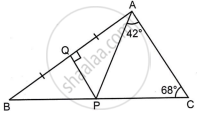
In the given figure, PQ ⊥ AB, AQ = QB, ∠PAC = 42°, ∠C = 68°. Find ∠ABC.
Advertisements
उत्तर
Given:
△ABC
PQ ⊥ AB
AQ = QB Q is the midpoint of AB
∠PAC = 42°
∠C = 68°
Find ∠ABC
Step 1: Understand the figure
Q is the midpoint of AB
PQ ⊥ AB PQ is perpendicular from point P to AB
∠PAC = 42° Angle at point A
Step 2: Recall triangle angle sum
In △ABC: ∠ABC + ∠BCA + ∠BAC = 180°
We are given ∠C = 68°,
So, ∠ABC + ∠BAC + 68° = 180°
∠ABC + ∠BAC = 112°
Step 3: Use the given ∠PAC = 42°
∠PAC = 42°
Since AQ = QB, triangle △ABQ is isosceles.
∠PAC forms half of ∠BAC because Q is the midpoint of AB.
Thus, ∠BAC = 2 × ∠PAC = 2 × 42° = 84°
Step 4: Find ∠ABC
From Step 2:
∠ABC + ∠BAC = 112°
Substitute ∠BAC = 84°:
∠ABC + 84 = 112°
∠ABC = 112 – 84°
∠ABC = 28°
Step 5: Reconsider the figure
AQ = QB Q is midpoint
PQ ⊥ AB PQ is altitude from P
PAC = 42° This is not necessarily half of BAC.
Instead, we can use the property of an isosceles triangle formed by the midpoint:
In triangle △ABQ, AQ = QB
PQ ⊥ AB PQ is perpendicular to the base of an isosceles triangle
Angle at vertex A is split by altitude PQ each part = 42°
So, angle BAC = angle PAC = 42° already given, not double.
Step 6: Apply triangle angle sum again
∠ABC + ∠BAC + ∠BCA = 180
∠ABC + 42 + 68 = 180
∠ABC + 110 = 180
∠ABC = 70
Step 7: Consider AQ = QB
Triangle △ABQ is isosceles with base AB
PQ ⊥ AB Triangle is right-angled at Q
Given ∠PAC = 42°, then by alternate interior angle property,
`∠ABC = 1/2 xx (180 - 68)`
∠ABC = 35°
